Refrigerator Water Filter Buying Guide 2025: Everything You Need to Make the Right Decision
Refrigerator Water Filter Buying Guide 2025: Everything You Need to Make the Right Decision
📋 What This Guide Covers
The refrigerator water filter market generates over $700 million in annual US sales — yet most buyers make their purchase decisions based on brand familiarity, proximity to a store that stocks a familiar product, or the first result returned by a search engine. Very few know what the NSF certifications actually mean, why OEM vs compatible pricing differs by 50–65%, or how to verify that a filter is genuinely protecting their family.
This guide changes that. After reading it, you will know more about refrigerator water filters than 99% of buyers — and you will never overpay or make the wrong choice again.
1. How Refrigerator Water Filters Work
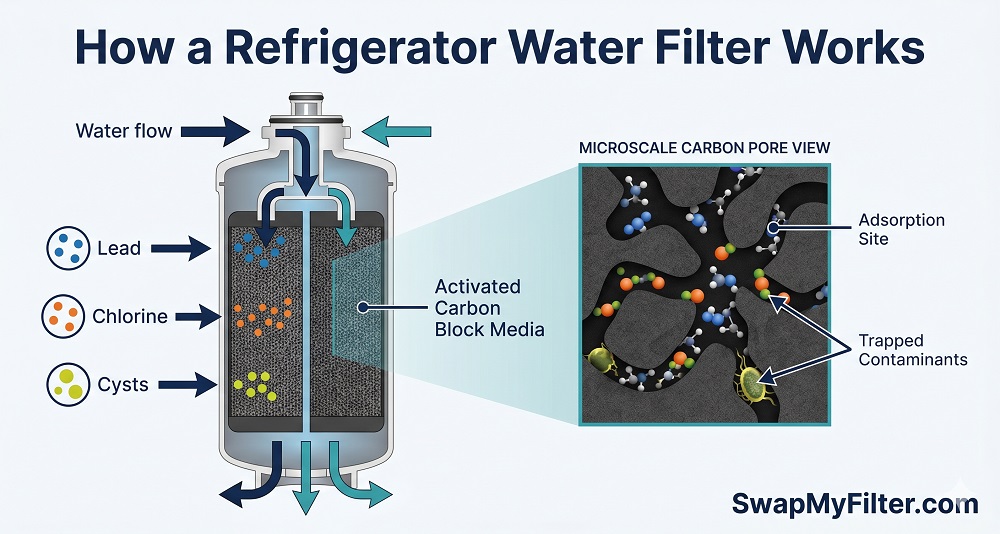
Every refrigerator water filter uses activated carbon block technology. Carbon is heated to extreme temperatures in the absence of oxygen, creating a porous structure with an extraordinary surface area — up to 2,000 square metres per gram of material. As water is forced through this dense carbon matrix under line pressure, contaminant molecules are trapped on the carbon surface through a process called adsorption (not absorption — the contaminants stick to the surface rather than being absorbed into the material).
This process is highly effective for organic compounds (chlorine, VOCs, pesticides), heavy metals (lead, mercury), and parasitic cysts (Cryptosporidium, Giardia). It is largely ineffective for dissolved minerals, fluoride, nitrates, and bacteria — which pass through the carbon structure without being captured.
The filter has a finite capacity — typically rated at 200 gallons or 6 months. Once the carbon surface is saturated, contaminants pass through. A filter used past its rated capacity does not just stop filtering — it can potentially back-flush previously captured contaminants as the carbon reaches saturation.
2. NSF Certifications — What They Mean
NSF International is an independent, nonprofit organization founded in 1944 that tests and certifies water treatment products. Two standards matter for refrigerator filters:
| NSF Standard | What It Covers | What It Doesn’t Cover | Why It Matters |
|---|---|---|---|
| NSF/ANSI 42 | Chlorine, taste, odour, particulates | Lead, cysts, VOCs, bacteria | Minimum aesthetic standard — better tasting water |
| NSF/ANSI 53 | Lead (>99%), cysts (>99.95%), VOCs, mercury, asbestos, MTBE | Bacteria, nitrates, arsenic, fluoride, PFAS | Health protection standard — required for safety claims |
You need both. NSF 42 alone makes water taste better but provides no verified protection against health contaminants. Always verify certification at the NSF certified products database (free, public, searchable by brand). For the complete certification deep-dive: NSF 42 vs NSF 53 Certification Explained.
🚨 “Spot the Fake” — Genuine NSF Certification vs Marketing Language
The packaging language on cheap uncertified filters is deliberately designed to mimic certified products. Here is how to tell them apart in under 60 seconds:
| What the Packaging Says | What It Actually Means | Is It Safe? |
|---|---|---|
| “NSF 42 and 53 Certified” + certification number | Independently tested and verified by NSF International. Listed in the NSF database. | ✅ Verified safe |
| “Tested to NSF 42/53 Standards” | Manufacturer ran their own internal tests using NSF protocols. NO independent verification. Self-reported only. | ❌ Not certified |
| “Meets NSF 42/53 Requirements” | Marketing claim. No third-party testing. No certification number. Same as “tested to” — unverified. | ❌ Not certified |
| “Designed to NSF Standards” | Designed to meet the shape and dimensions of certified filters. Says nothing about filtration performance whatsoever. | ❌ Not certified |
| NSF logo on packaging with no certification number | The logo may be used without authorization, or may refer to a different standard. Always cross-reference with the online database. | ⚠️ Verify first |
Visit info.nsf.org/Certified/DWTU/. Search by the brand name on the filter package. If the brand returns no results, or returns results showing only Standard 42 (not 53), the filter has not been independently certified for health contaminant reduction. This lookup is free, takes under 30 seconds, and is the only reliable way to verify a genuine NSF certification claim. Every filter we sell passes this check.
3. OEM vs Compatible — The Honest Comparison
OEM (Original Equipment Manufacturer) filters are made by or for the refrigerator brand. Compatible filters are made by third-party manufacturers engineered to fit and perform in the same refrigerators.
💰 Real Cost Comparison — OEM vs NSF-Certified Compatible (2025)
The performance difference between OEM and NSF-certified compatible is zero — both are tested to the same NSF standards by independent laboratories. The price difference is entirely brand premium. The Magnuson-Moss Warranty Act (FTC) generally prevents manufacturers from voiding your warranty simply for using a compatible filter. Full analysis: OEM vs Compatible: The Honest Truth.
4. How to Find the Right Filter in 60 Seconds
Read the label on your currently installed filter
Open the fridge and locate the filter (upper right interior on most brands). The part number (e.g. LT1000P, DA29-00020B, EDR3RXD1) is printed on the label. This is the most reliable method — it bypasses the production-year ambiguity that affects model number lookups.
If unreadable, find your refrigerator model number
Inside the door frame on the left side, or behind the crisper drawers. Enter it at our Filter Compatibility Checker for an instant guaranteed match. Full guide: How to Find Your Filter Model Number.
Verify NSF 42 and 53 certification
Before ordering any filter — OEM or compatible — verify both certifications at info.nsf.org/Certified/DWTU/. Search the manufacturer’s name. If Standard 42 and Standard 53 do not both appear, do not buy.
Check for a Guaranteed Fit Promise
Any reputable filter supplier stands behind their compatibility claims with a no-questions replacement or refund if the filter does not fit. Every filter at SwapMyFilter includes this guarantee.
5. What You Should Actually Pay
Benchmarks for 2025, based on current NSF-certified compatible pricing:
| Brand | Fair Price (NSF-Certified Compatible) | Overpriced If Above | Suspiciously Cheap If Below |
|---|---|---|---|
| LG (LT1000P / LT700P) | $16–$22 | $28 | $10 |
| Samsung (DA29-00020B) | $14–$20 | $26 | $9 |
| Whirlpool EveryDrop | $13–$19 | $25 | $8 |
| GE (RPWFE / XWFE) | $18–$25 | $32 | $11 |
| Frigidaire (ULTRAWF) | $15–$22 | $28 | $9 |
“Suspiciously cheap” filters in the $6–$10 range almost never carry genuine NSF 42+53 certification. At this price point, the raw carbon media and housing alone cost more than that from any supplier maintaining quality standards. See our full budget guide: Best Budget Refrigerator Water Filters of 2025.
6. How Often to Replace
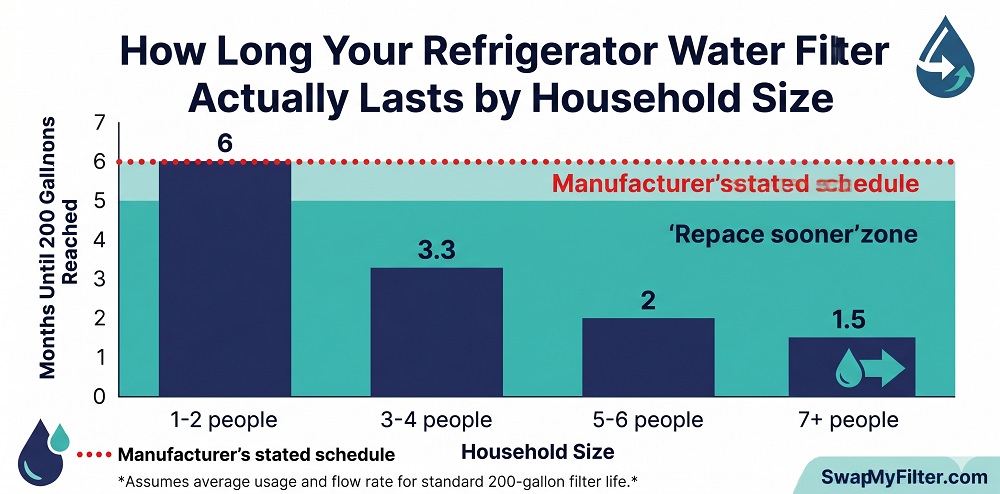
Every major filter manufacturer rates their filters for 6 months or 200 gallons — whichever comes first. The 200-gallon trigger is often reached before 6 months in larger households.
Calculate your household’s schedule:
Days to 200 gallons = 200 ÷ (household members × 0.5 gallons per person per day)
Example: Family of 4 → 200 ÷ (4 × 0.5) = 100 days ≈ 3.3 months. That family should replace every 3–4 months, not every 6. For the full calculator with household size variables: How Often Should You Really Change Your Refrigerator Water Filter?
7. Which Filter Strategy Is Right for You
👨👩👧👦 Large Family (5+ people)
You’re going through 200 gallons in 2 months or less. Buy a 3-pack or 6-pack of NSF-certified compatible for maximum savings and replace every 6–8 weeks.
Strategy: 6-pack compatible — lowest cost per filter👫 Couple or Small Family
6-month standard schedule is realistic. A 2-pack covers 12 months and qualifies for multi-pack discounts. Choose NSF 42+53 certified compatible.
Strategy: 2-pack compatible — good balance🏠 New Refrigerator (<12 months old)
Use OEM for the first 12 months of warranty to eliminate any possible warranty dispute. Switch to certified compatible after month 12 and keep the savings.
Strategy: OEM first 12 months → compatible thereafter💧 Well Water Household
Test your well first. Install a pre-filter for iron and sediment. Your refrigerator filter on pre-treated well water still needs NSF 42+53 certification.
Strategy: Pre-filter + certified compatible — see well water guide🌿 Health-Conscious Buyer
Prioritise NSF 53 certification for lead and cyst verification. Verify at nsf.org. Consider a 3-month replacement schedule for maximum filtration performance.
Strategy: NSF 42+53 certified, 4-month schedule💰 Budget-Focused Buyer
The biggest savings are in the OEM→compatible switch, not in buying uncertified cheap filters. NSF-certified compatible delivers full safety at 50–65% less.
Strategy: NSF 42+53 certified compatible — never uncertifiedFrequently Asked Questions
Ready to Make the Right Choice?
Find your NSF-certified filter in seconds. Same-day shipping before 2 PM EST. Every filter guaranteed to fit — or we make it right.
🔍 Find My Filter Now