Is Refrigerator Filtered Water Safe to Drink? The Science-Backed Answer (2025)
Is Refrigerator Filtered Water Safe to Drink? The Science-Backed Answer (2025)
Yes — refrigerator filtered water from a properly maintained, NSF 42+53 certified filter is safe to drink for the vast majority of households on municipal water. There are specific conditions under which the answer changes to “conditionally safe” or “no” — those are covered in detail below.
Under What Conditions Is Refrigerator Filtered Water Safe?
Safe — Standard Conditions
Municipal water supply · NSF 42+53 certified filter · Replaced on schedule · No known infrastructure issues
Conditionally Safe
Old home plumbing (pre-1986) · Near industrial area · Private well with pre-treatment · Boil water advisory in effect
Not Sufficient Alone
Active boil water order · Confirmed bacterial contamination · Well water without treatment · Lead service line with high lead levels
The Science: What NSF-Certified Refrigerator Filters Actually Remove
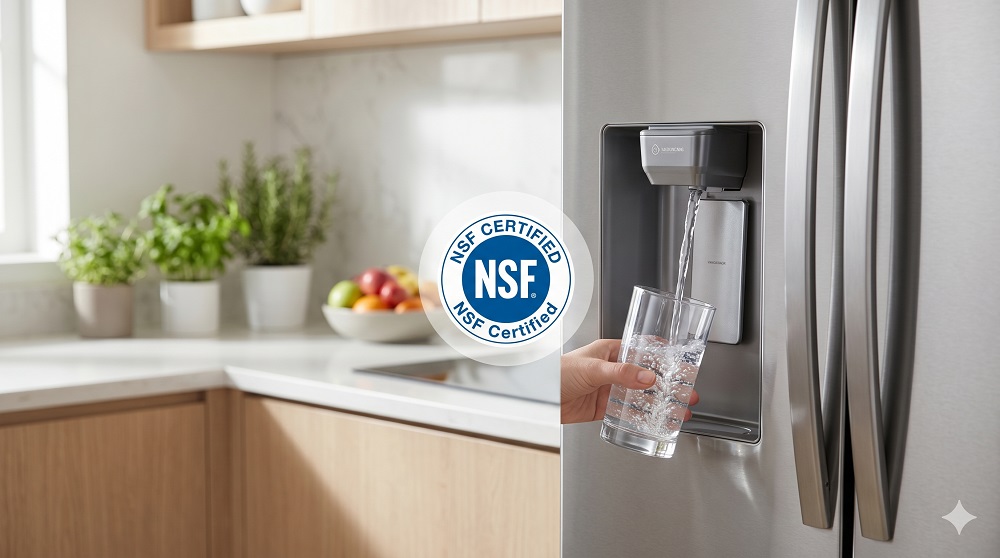
The safety of refrigerator filtered water is directly determined by what your specific filter removes — which is defined by its NSF certification. According to NSF International’s Water Filter Guide, a filter certified to both NSF/ANSI 42 and NSF/ANSI 53 provides:
| Contaminant | NSF Certification | Reduction Rate | Health Relevance |
|---|---|---|---|
| Chlorine (taste and odour) | NSF 42 | Greater than 97% | Aesthetic and potential long-term exposure concern |
| Lead | NSF 53 | Greater than 99% | Critical — no safe exposure level per EPA |
| Cysts (Cryptosporidium, Giardia) | NSF 53 | Greater than 99.95% | Parasitic illness — important for immunocompromised |
| Trihalomethanes (THMs) | NSF 53 | Greater than 95% | Chlorination byproducts, potential carcinogens |
| VOCs (benzene, toluene) | NSF 53 | Greater than 99% | Industrial chemicals, carcinogens |
| Mercury | NSF 53 | Greater than 96% | Neurotoxin |
| Asbestos | NSF 53 | Greater than 99% | Carcinogen |
| Bacteria | Not covered | None | Requires pre-treatment for well water |
| Nitrates | Not covered | None | Infant risk — requires RO or ion exchange |
| PFAS / forever chemicals | Not covered by 42/53 | Partial (unverified) | Requires NSF 58 RO or NSF 58 specialised media |
The Three Conditions That Change the Answer
1. Your Filter Is Overdue for Replacement
A saturated filter provides no protection. Once carbon capacity is reached, lead, cysts, and VOCs pass through at essentially the same concentration as unfiltered water. An expired filter that appears to be working (water flows, no visible change) may provide zero health protection. The 6-month / 200-gallon rule exists for this reason. Signs it is overdue: 7 Signs Your Filter Needs Replacing.
2. Your Filter Is Not NSF 42+53 Certified
A filter certified only to NSF 42 reduces chlorine taste but has no verified lead or cyst protection. Many inexpensive marketplace filters carry NSF 42 only — the packaging looks similar but the safety coverage is fundamentally different. Always verify at info.nsf.org before trusting the packaging.
3. Your Water Supply Has Specific Contamination
Municipal water in the US is regulated by the EPA Safe Drinking Water Act and meets strict standards at the treatment plant. However, lead can leach into water between the treatment plant and your tap — from old lead service lines (especially in homes built before 1986) or lead-soldered plumbing joints. In homes with confirmed lead service lines, even NSF 53-certified filtered water should be supplemented with flushing the supply line before drawing water. The CDC provides guidance on lead in water for homes with older plumbing.
Refrigerator Filtered Water vs Bottled Water — Which Is Safer?
This is a comparison almost no guide makes honestly. Bottled water is regulated by the FDA (not the EPA) and is not subject to the same public reporting requirements as municipal water. According to NRDC research on bottled water purity, roughly 22% of tested bottled water brands contained contaminants above state health limits, and most do not publish contaminant testing data publicly.
NSF 42+53 certified refrigerator filtered water from a replaced-on-schedule filter is, for most households, as safe or safer than bottled water — at 400–800 times lower cost per gallon, with dramatically less plastic waste.
The 2025 Question: What About PFAS, Microplastics, and “Forever Chemicals”?
Search interest for PFAS (per- and polyfluoroalkyl substances) and microplastics in drinking water has surged in the last two years — and it is a legitimate concern. Here is an honest assessment of what your refrigerator filter does and does not do for these emerging contaminants:
| Emerging Contaminant | NSF 42 Coverage | NSF 53 Coverage | What Actually Removes It |
|---|---|---|---|
| PFAS / PFOA / PFOS (“forever chemicals”) | None | Partial — unverified by standard | NSF 58 certified RO system, or NSF 58 certified activated carbon with PFAS-specific media |
| Microplastics | Partial (larger particles) | Yes — NSF 53 covers particulates including microplastic-sized cysts | NSF 53 carbon block filter provides meaningful reduction of microplastics in the 1+ micron range |
| Pharmaceuticals and hormones | None | Not covered by standard | NSF 401 certified filters specifically (rare in refrigerator filters) |
| Nitrates | None | None | NSF 58 certified RO system or NSF 58 certified ion exchange |
| Arsenic | None | None | NSF 58 certified RO system |
Standard NSF 42+53 certified refrigerator carbon block filters were not designed with PFAS removal as a target — and the NSF 53 standard does not include PFAS reduction testing. Some activated carbon block filters show partial PFAS reduction in independent tests, but this is not verified by the standard. If PFAS contamination is a specific concern in your area — check your utility’s CCR at EPA.gov/ccr — a dedicated NSF 58 certified reverse osmosis system is the appropriate supplemental solution. The refrigerator NSF 42+53 filter remains valuable for its verified lead, cyst, chlorine, and VOC reduction — acknowledging its limits on emerging contaminants makes its claims for what it does cover more credible, not less.
For households specifically concerned about pharmaceuticals, the NSF/ANSI 401 standard (Emerging Contaminants/Incidental Compounds) covers prescription drugs, over-the-counter medications, and other trace organic compounds. Very few refrigerator-format filters currently carry NSF 401 certification — it is primarily found in under-sink and whole-house filter systems. If NSF 401 is a priority, consult the NSF certified products database and filter specifically for Standard 401 certification.
Frequently Asked Questions
Get NSF-Certified Safe Filtered Water
Every filter we sell carries NSF 42 and 53 dual certification — independently verified lead and cyst protection for your family. Find your filter in seconds.
🔍 Find My Certified Filter