Inline vs Internal Refrigerator Water Filters: What’s the Difference and Which Do You Need?
Inline vs Internal Refrigerator Water Filters: What’s the Difference and Which Do You Need?
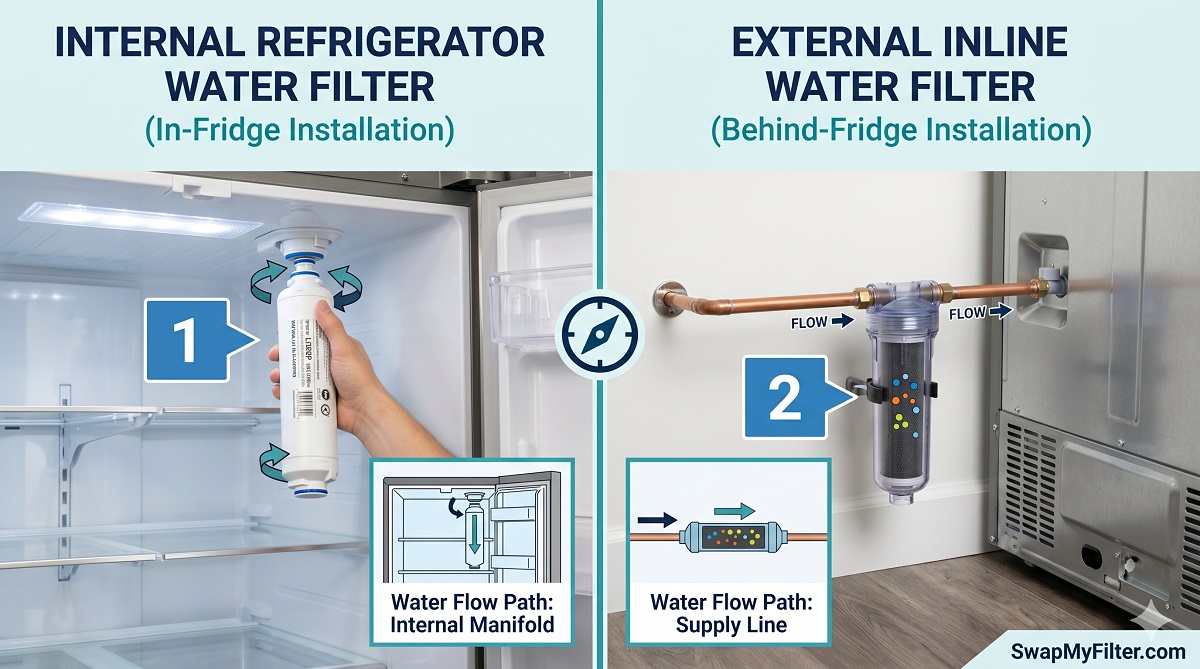
Internal filters are built into the refrigerator (twist-in or push-in inside the fridge compartment, or in the bottom grille) — this is what 95%+ of modern refrigerators use. Inline filters are external units installed on the supply water line behind the refrigerator — used for older fridges without built-in filter housing, or as a pre-filter stage for well water.
Internal Refrigerator Filters — The Modern Standard
Every major refrigerator sold in the US since approximately 2000 includes a built-in internal water filter. These come in three sub-types:
- Twist-in internal (most common): Cylindrical cartridge in the upper interior of the fridge, removed by rotating counterclockwise. Used by LG (LT1000P, LT700P), Whirlpool (EDR series), Maytag (UKF8001), KitchenAid, Amana, and Kenmore (Whirlpool-built).
- Push-in internal: Cylindrical cartridge with push-button eject, located in the upper right interior. Used by Samsung (DA29-00020B), GE (RPWFE, XWFE, MSWF), and Frigidaire (ULTRAWF, PAULTRA).
- External grille push-in: Located in the bottom-left front grille panel. Used by Samsung 4-Door Flex models (DA97-17376B). External but brand-specific — not a true inline filter.
Inline Filters — When You Need an External Solution
Inline filters are installed directly on the water supply line that feeds your refrigerator — typically the copper or braided supply tube running from the wall valve to the refrigerator. They filter all water before it enters the refrigerator.
You need an inline filter in three specific situations:
- Older refrigerator without a built-in filter housing: Many refrigerators manufactured before 2000 dispense and ice directly from unfiltered supply water. An inline filter on the supply line provides filtration.
- As a pre-filter for well water: A sediment and iron-reduction inline filter protects the built-in refrigerator filter from the contaminants that clog and bypass it. See: Best Refrigerator Water Filters for Well Water.
- For additional filtration capacity: In areas with very high contaminant loads, an inline pre-filter extends the life of the internal refrigerator filter significantly.
Head-to-Head Comparison
🔵 Internal Filter (Built-In)
- Installed inside the refrigerator
- Brand-specific — must match your fridge model exactly
- No tools required — twist or push replacement in 2 minutes
- NSF 42+53 certified options from $13–$25
- 6-month / 200-gallon replacement schedule
- Filter indicator light tracks replacement timing
- Standard for all modern refrigerators (2000+)
🟢 Inline Filter (External)
- Installed on supply line behind refrigerator
- Universal — fits any 1/4″ supply line
- Requires shutting off water supply to replace
- NSF 42+53 certified options from $20–$45
- 6-month replacement schedule (varies by type)
- No automatic reminder — manual tracking needed
- Best for older fridges or as pre-filter for well water
| Factor | Internal Filter | Inline Filter | Which Wins |
|---|---|---|---|
| Installation ease | 2 minutes, no tools | Requires water shutoff | Internal |
| Cost per filter | $13–$25 (compatible) | $20–$45 (varies) | Internal |
| Compatibility | Brand-specific only | Universal (1/4″ line) | Inline |
| Filtration quality | NSF 42+53 certified | NSF 42+53 certified | Equal |
| Well water use | Insufficient alone | Excellent as pre-filter | Inline |
| Older fridge support | N/A (fridge must have housing) | Works with any fridge | Inline |
The Right Choice for Most Households
If your refrigerator has a built-in filter housing — use the internal filter. It is faster, cheaper, and simpler. If you have an older fridge without filter housing, or you are on a private well — use an inline filter on the supply line, with or instead of the internal filter depending on your specific needs.
Installing an Inline Filter — What to Know
Inline filters connect to the standard 1/4-inch compression fitting supply line used by virtually all refrigerators in North America. Installation involves:
- Turning off the supply valve behind the refrigerator
- Disconnecting the supply line from the valve
- Connecting the inline filter housing in-line using compression fittings
- Reconnecting to the refrigerator supply inlet
- Turning on the supply and checking for leaks
This is a DIY-friendly installation that takes approximately 20–30 minutes and requires no special tools beyond an adjustable wrench. If you are not comfortable with plumbing connections, a licensed plumber can install it in under 30 minutes.
Clearance Requirements and the Service Loop — The Detail Most Guides Skip
The single most overlooked element of inline filter installation is what happens after the filter is in place: you still need to pull the refrigerator out periodically for cleaning, levelling, or future repairs. A rigid supply line with the filter installed directly leaves no slack — pulling the fridge out without disconnecting the line will stress the fittings and potentially kink or crack the supply tube.
A service loop is a deliberate 8–12 inch arc of extra supply line behind the refrigerator. Use a braided stainless steel flexible supply line (not rigid copper) and leave enough slack that the refrigerator can be pulled 18–24 inches away from the wall without any tension on the connections. Route the loop so it sits above the floor and cannot be pinched when the fridge is pushed back into position. Braided stainless supply lines with 1/4-inch compression fittings are available at hardware stores for under $15 and are vastly superior to the plastic supply tubing that ships with most refrigerators — they are kink-resistant, rodent-resistant, and rated for 10+ years of continuous pressure.
Minimum clearance requirements:
- Allow at least 2 inches of clearance between the filter housing and the rear wall — enough to grip and rotate the filter cap during replacement
- Install the filter body vertically or at no more than 45 degrees from vertical to ensure even water flow through the media
- Keep the filter housing accessible without fully removing the refrigerator — position it no more than 24 inches from the floor if possible
- Never install the filter housing behind a wall panel or in an enclosed cabinet without a service access point
Whether inline or internal, any filter you use should carry NSF/ANSI 42 and 53 certification — independently verifiable at NSF International’s certified products database. The EPA’s drinking water contaminant guidance identifies lead, cysts, and VOCs as the key contaminants that NSF 53 certified filters specifically address — the certification standard that defines what “filtered water” actually means from a health protection standpoint.
Frequently Asked Questions
Find the Right Filter for Your Setup
Whether you need an internal replacement or guidance on inline options for your refrigerator — our team can match you to the right solution. Same-day shipping on all in-stock filters.
🔍 Find My Filter