How to Replace a Refrigerator Water Filter (Universal Step-by-Step Guide for Every Brand)
How to Replace a Refrigerator Water Filter (Step-by-Step Guide for Every Brand)
Replacing a refrigerator water filter is one of the simplest home maintenance tasks you will ever do — and one of the most neglected. Most people do it too late, do it wrong, or spend 20 minutes confused in front of an open fridge door.
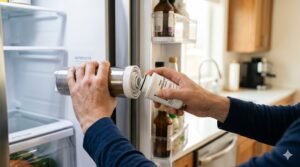
This guide ends all of that. Whether your refrigerator is an LG, Samsung, Whirlpool, GE, Kenmore, Frigidaire, or Maytag, you will find step-by-step instructions here that work for your exact filter type — no tools, no plumber, no frustration.
Locate filter → turn off ice maker → remove old filter → insert new filter → flush 2–3 gallons → reset the filter light. Total time: under 5 minutes.
According to the NSF International Water Filter Guide, replacing your refrigerator filter on schedule is one of the most effective steps a household can take to reduce chlorine, lead, and waterborne cysts from drinking water.
Why Replacing Your Filter on Schedule Matters
Your refrigerator water filter uses activated carbon block technology to trap chlorine, lead, cysts (Cryptosporidium and Giardia), VOCs, and dozens of other contaminants before they reach your glass. Once the carbon is saturated, it stops working — and a long-expired filter can actually release previously captured contaminants back into your water, a process called back-flushing.
The US EPA recommends replacing refrigerator filters every 6 months or 200 gallons. You can verify current EPA guidance on drinking water protection at EPA.gov Drinking Water FAQs.
What You Will Need
- Your replacement filter — use our Filter Compatibility Checker if unsure which one
- A small towel to catch drips
- That is genuinely everything — no tools required
Not sure which filter fits your refrigerator?
Enter your refrigerator model number for an instant, guaranteed match — OEM or NSF-certified compatible.
Find My Filter →Step-by-Step: How to Replace a Refrigerator Water Filter
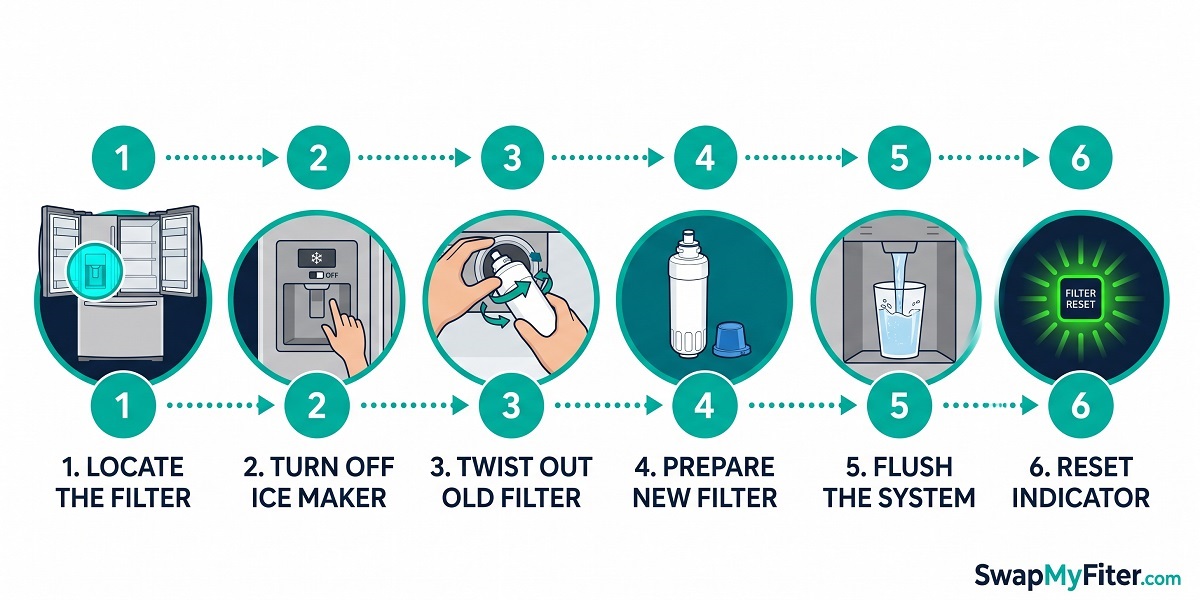
Locate Your Filter
Refrigerator water filters sit in one of three places: inside the upper fridge compartment (most common), in the bottom front grille, or inside the freezer. Look in the upper left or right corner of the fridge interior first.
Turn Off the Ice Maker
Flip the ice maker arm up or press the off switch inside the freezer. This prevents water demand during the swap and stops dripping. Most modern housings shut off automatically when the filter is removed, but this takes 5 seconds and eliminates any risk.
Remove the Old Filter
Twist-type: Rotate counterclockwise about a quarter-turn, then pull straight out.
Push-button type: Press the release button — the filter pops out slightly. Pull the rest of the way out.
Have your towel ready — a tablespoon or two of water will drip. Completely normal.
💡 Filter stuck? Wrap it in a rubber band or rubber glove for grip. Apply steady counterclockwise pressure — do not jerk or force it.Remove the Cap and Insert the New Filter
Remove the protective plastic cap from the O-ring end of the new filter before inserting. This is the most common installation mistake — the cap blocks the water seal and causes leaks every time it is left on.
Align with the housing notch, then:
Twist-type: Push in and rotate clockwise until firmly locked.
Push-button type: Push in until you hear and feel a firm click.
Flush 2–3 Gallons — Do Not Skip
New filters contain loose carbon particles that make the first water grey or cloudy. This is harmless but do not drink it. Run the dispenser continuously for 4–6 minutes and discard the water. Continue until the water runs completely clear.
💡 Use flushed water to water plants — no need to waste it down the drain.Reset the Filter Indicator Light
The filter indicator runs on a timer — it will not reset automatically. Hold the reset button for 3–5 seconds depending on your brand. Turn the ice maker back on. See the brand-specific reset guide in the section below.
Brand-by-Brand Filter Replacement Guide
| Brand | Filter Location | Removal Type | Reset Method |
|---|---|---|---|
| LG | Upper right interior | Quarter-turn counterclockwise | Hold “Water Filter” 3–5 sec |
| Samsung | Right interior or bottom-left | Push-eject or twist CCW | Hold “Child Lock” or “Filter Reset” 3 sec |
| Whirlpool | Upper interior or bottom grille | Quarter-turn counterclockwise | Hold “Filter Reset” 3 sec |
| GE | Upper right interior | Push-eject button | Hold “Reset Water Filter” 3 sec |
| Kenmore | Varies by manufacturer | Varies | Hold “Water Filter Reset” 3–5 sec |
| Frigidaire | Upper right interior | Push-eject button | Hold “Reset” 3 sec |
| Maytag | Upper interior or grille | Quarter-turn counterclockwise | Hold “Filter Reset” 3 sec |
Pro-Tips for a Stuck Filter
A stuck refrigerator water filter is one of the most common post-replacement problems. Work through these steps in order:
- Rubber band trick: Wrap two thick rubber bands around the filter body. The added grip resolves most stuck filters immediately.
- Rubber glove grip: Put on a rubber glove and retry the quarter-turn. Rubber grip is the most effective tool for stuck filters.
- Warm cloth: Wrap a warm (not hot) damp cloth around the filter housing for 2–3 minutes. Warmth softens mineral deposits sealing the O-ring to the housing.
- Release pressure first: Hold the water dispenser lever for 10–15 seconds to relieve line pressure before attempting removal.
- Power cycle: Unplug the refrigerator for 60 seconds. This fully depressurises the water valve and often allows a stuck filter to release.
If you hear cracking, see the housing deforming, or the filter body separates from the thread — stop immediately. Contact the manufacturer’s service line. Forcing it can cause an internal water leak.
What to Expect After Installation
- Grey or cloudy water for the first gallon or two — harmless carbon dust. Keep flushing.
- Slower dispenser flow initially — normalises after flushing. If it stays slow, the filter may not be fully seated.
- Small drips at the housing — should stop within 10 minutes. If leaking persists, remove and reinsert the filter ensuring the O-ring cap was removed.
- Filter indicator still red — hold the reset button for the full 3–5 seconds. A quick tap will not reset it.
OEM vs Compatible Replacement Filters
Once you know how to replace a refrigerator water filter, the next question is which filter to buy. Genuine OEM filters from LG, Samsung, or Whirlpool cost 40–60% more than NSF-certified compatible alternatives that perform identically in independent lab testing.
The critical factor is NSF/ANSI 42 and 53 certification — not the brand on the box. You can verify any filter’s certification directly on the NSF International Certified Products Database (free, public).
Shop all NSF-certified filters for your refrigerator at our filter store, or browse by brand: LG filters · Samsung filters · Whirlpool filters · GE filters.
How Often Should You Replace Your Filter?
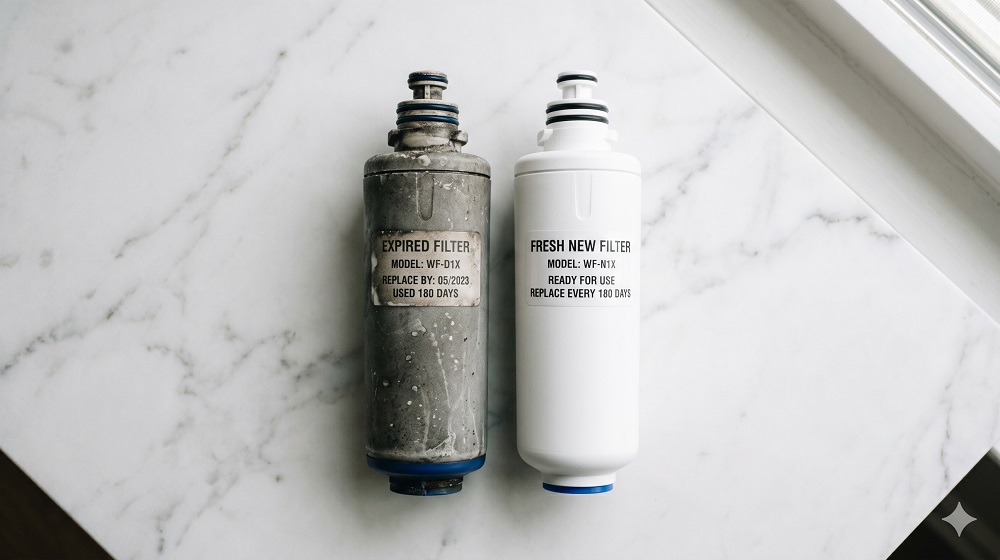
Every 6 months or 200 gallons — whichever comes first. Set a calendar reminder the day you install. Signs your filter is overdue: chlorine taste returning, reduced dispenser flow, or the filter indicator turning red.
Ready to Swap Your Filter Today?
Find your exact NSF-certified replacement in seconds. Same-day shipping before 2 PM EST. Guaranteed to fit — or we make it right.
🔍 Find My Filter NowDo I need to turn off the water supply to change a refrigerator water filter?
No. The filter housing contains an automatic shut-off valve that stops water flow the moment you remove the filter. You will see a small drip — have a towel ready — but no significant water flow. Only very old external inline filters require shutting off the supply line.
Why is my water grey or cloudy after installing a new filter?
Completely normal. New activated carbon filters contain fine loose carbon particles that make the first water grey or milky. It is harmless. Run 2–3 gallons through the dispenser and discard it. The water will run clear within a few minutes of flushing.
Can I use a compatible filter instead of OEM?
Yes — provided the compatible filter carries NSF/ANSI 42 and 53 certification. NSF certification requires independent laboratory testing of the actual filtration performance. A certified compatible filter has been verified to reduce the same contaminants (chlorine, lead, cysts, VOCs) to the same standard as certified OEM. Verify any filter’s certification at info.nsf.org/Certified/DWTU/
My filter light will not reset — what do I do?
Hold the button for the full 3–5 seconds — a quick tap will not work. The button and method vary by brand. The most common issue is not holding long enough. If you have tried for the full duration and the light stays on, check that the filter is fully seated — on some models the control board detects filter installation. Contact our team with your brand and model number for specific guidance
Can I run my refrigerator without a water filter?
Yes — most refrigerators accept a bypass plug that allows the dispenser and ice maker to operate without filtration. Your water will be unfiltered tap water, which is safe in most municipal water areas for short periods but not recommended long-term for drinking. Contact us and we can source a bypass plug compatible with your model.
How long does a refrigerator water filter last?
Most filters are rated for 6 months or 200 gallons. Large households using the dispenser heavily may reach 200 gallons in 4–5 months. Set a calendar reminder on installation day. Signs the filter is overdue: chlorine returning to the water’s taste, reduced dispenser flow, or the filter indicator light turning red or orange.