How Long Does a Refrigerator Water Filter Last? (The Real Numbers by Household Size)
How Long Does a Refrigerator Water Filter Last? (The Real Numbers by Household Size)
The Household Size Calculator — Your Real Replacement Schedule
Formula:
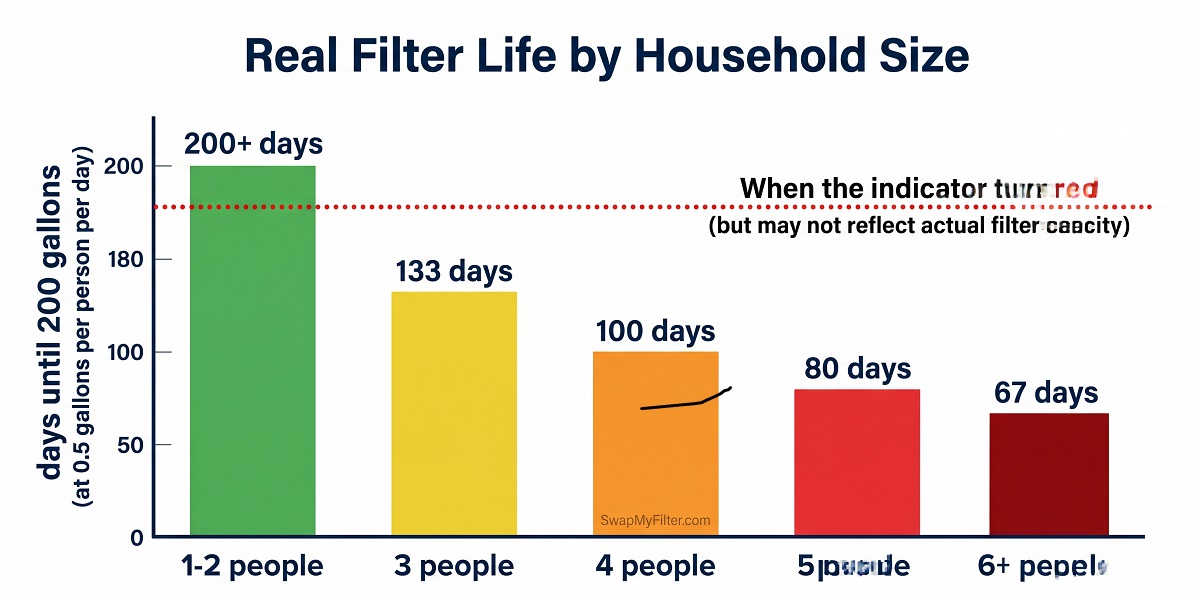
Days until 200 gallons = 200 ÷ (household members × gallons per person per day)
Industry-standard household dispenser usage is approximately 0.5 gallons per person per day (combined drinking and ice). Heavy users (cooking with filtered water, frequent ice) may be closer to 0.75–1.0 gallons per person per day.
Red values = filter reaches 200 gallons before the 6-month indicator triggers. For these households, the filter may be spent while still showing a green/blue indicator light on the refrigerator panel.
Why the Filter Indicator Light Is a Poor Guide for Larger Households
Every major refrigerator brand — LG, Samsung, Whirlpool, GE, Frigidaire — uses a 180-day countdown timer as the filter indicator. According to the EPA WaterSense data on household water consumption, a family of 4 using the refrigerator dispenser at standard rates reaches 200 gallons in approximately 100 days — 80 days before the indicator triggers. During those 80 days, the filter may be operating past its rated capacity while the indicator still shows green.
The indicator light is useful for small households and single occupants who may not reach 200 gallons before 6 months. For families of 3 or more, the gallon count should drive the replacement decision — not the indicator.
Signs Your Filter Needs Replacing — Regardless of the Indicator
- Chlorine taste or smell returns — the clearest sign carbon capacity is exhausted
- Noticeably slower dispenser flow — indicates physical clogging from captured particles
- Bad-smelling or small ice cubes — the ice maker shares the same filtered supply
- Cloudy water that persists after the initial installation flush
- More than 200 gallons consumed (use the household size table above)
- More than 12 months since last replacement — maximum regardless of usage
For the complete warning sign guide: How to Tell If Your Refrigerator Water Filter Is Bad. For the science behind carbon saturation and why expired filters can actually worsen water quality: What Does a Refrigerator Water Filter Remove?
The Carbon Saturation Curve — Why Filters Don’t Fail All at Once
⚠️ The Hard Water Variable — Why Your Real Schedule May Be Even Shorter
The household size calculator above assumes the 200-gallon capacity limit is driven by chemical saturation — the carbon surface filling with adsorbed contaminants. In soft to moderately hard water (below 120 mg/L), this is accurate. In hard water above 180 mg/L — common in the Southwest, Texas, Florida, and the Midwest — a second failure mechanism accelerates the replacement schedule: physical clogging from calcium and magnesium scale deposits.
Hardness minerals do not bond to carbon, but they deposit on and within the carbon block’s porous surface as water passes through. This physical scale progressively narrows the flow pathways, reducing dispenser flow rate before the carbon reaches chemical saturation. The result: in very hard water, the filter may need replacement 20–30% sooner than the household size calculator suggests — not because the carbon is chemically spent, but because scale has physically blocked the media.
| Water Hardness | mg/L | Gallon Calculator Adjustment | Practical Schedule |
|---|---|---|---|
| Soft | 0–60 | None — gallon calculation accurate | Use household size calculator as-is |
| Moderately Hard | 61–120 | Reduce calculated days by 5–10% | Minor adjustment — still close to calculated |
| Hard | 121–180 | Reduce calculated days by 15–20% | Monitor flow rate from month 3 onwards |
| Very Hard | 181–300 | Reduce calculated days by 20–30% | Replace when flow noticeably slows regardless of calendar |
| Extremely Hard | 300+ | Physical clogging dominant — replace when flow reduces | Flow rate is more reliable indicator than gallon count |
The best hard water indicator: monitor dispenser flow rate visually. A glass of filtered water should fill in 8–12 seconds. When it takes 20+ seconds, physical clogging has significantly reduced effective filtration — replace regardless of whether the gallon calculator says you have capacity remaining. For hard water regions, our Best Refrigerator Filters for Hard Water guide includes region-specific schedules and pre-filter recommendations.
Activated carbon filters do not reach a clear pass/fail threshold — they degrade along a saturation curve. As the carbon surface fills with adsorbed contaminants, it progressively loses capacity to capture additional molecules. This means:
- At 0–100 gallons: Full rated capacity — maximum lead, cyst, and chlorine reduction
- At 100–160 gallons: Declining capacity — chlorine reduction begins degrading first
- At 160–200 gallons: Approaching limit — lead and VOC reduction still largely intact
- At 200–300 gallons: Past rated capacity — all reduction rates declining significantly
- Beyond 300 gallons: Potential reverse adsorption — previously captured contaminants may re-enter water
This is why the 200-gallon rating exists — not as an arbitrary cutoff but as the point beyond which the manufacturer can no longer certify the filter’s performance to NSF standards.
Frequently Asked Questions
Replace on Your Real Schedule — Not the Manufacturer’s
Use the household size calculator to find your actual replacement date. Order an NSF-certified compatible filter from $15.95. Same-day shipping. Never run overdue again.
🔍 Find My Replacement Filter