Best Refrigerator Water Filters for Well Water (2025): What Actually Works — and What Doesn’t
Best Refrigerator Water Filters for Well Water (2025): What Actually Works — and What Doesn’t
If your home is on a private well, your refrigerator water filter is working harder than it was designed to — and probably failing silently in ways you cannot taste or see. Standard refrigerator carbon filters were engineered for treated municipal water. They assume chlorine has already killed bacteria, that heavy metals like iron have already been removed, and that the water pressure and sediment load are within municipal supply specifications.
Private well water presents a completely different challenge — and the information circulating online (including on Amazon product pages) consistently underestimates the problem. This guide gives you the unfiltered truth.
According to a major USGS National Water Quality Assessment, approximately 23% of domestic well water in the United States contains at least one contaminant at a level of potential health concern. The most common are nitrates, arsenic, coliform bacteria, and uranium — none of which a standard refrigerator carbon filter certified to NSF 42 and 53 is designed to remove. Buying an “NSF-certified” filter for well water without understanding this limitation is one of the most common and dangerous misunderstandings in home water treatment.
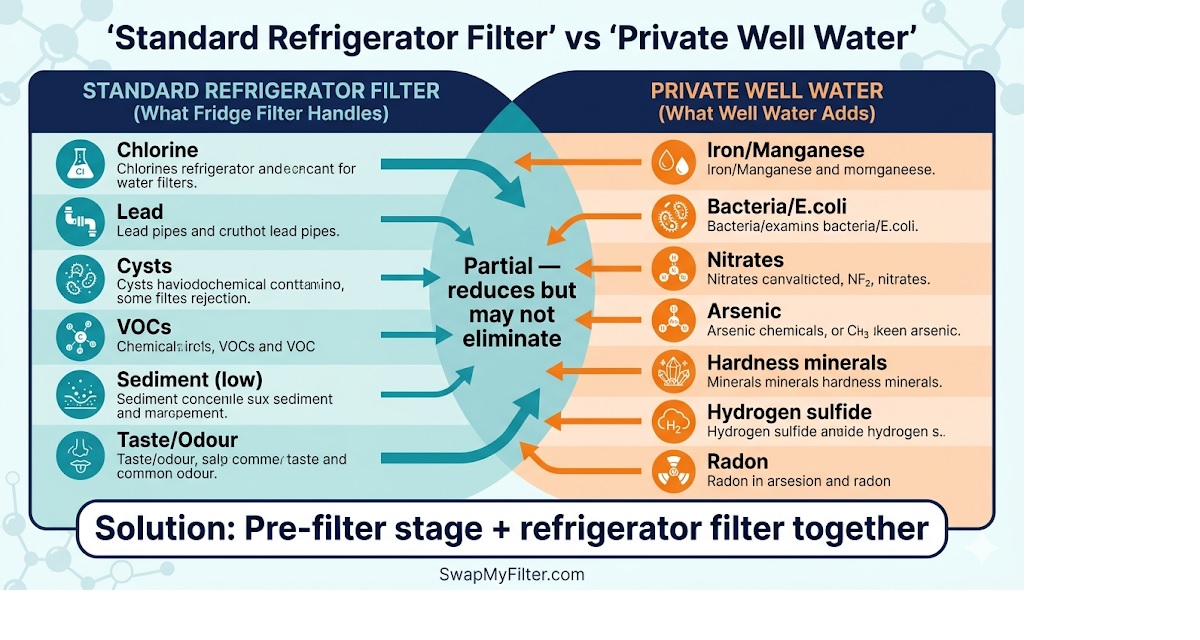
What Private Wells Actually Contain — The USGS Data
The USGS National Water Quality Assessment Program has tested over 20,000 domestic wells across the United States. Their findings are striking:
| Contaminant | % of US Wells Above Concern Level | Standard Fridge Filter Removes? | Health Concern |
|---|---|---|---|
| Nitrates | 8–20% (varies by region) | ✕ No | Infant “blue baby” syndrome, cancer risk |
| Coliform bacteria | Up to 34% (older wells) | ✕ No | Gastroenteritis, serious illness |
| Arsenic | 6–10% (New England, West, Midwest) | ✕ No | Long-term cancer risk |
| Iron and manganese | 30–40% | ⚡ Partial | Staining, taste — clogs carbon filter |
| Lead | Variable (from pump/pipes) | ✓ Yes (NSF 53) | Neurotoxin |
| Radon (dissolved) | Up to 12% (granite regions) | ✕ No | Carcinogen |
| Hardness minerals | 85%+ have some hardness | ✕ No | Scale buildup — shortens filter life |
| Hydrogen sulfide | Common in specific geologies | ⚡ Partial | “Rotten egg” odour |
| Cysts (Giardia, Cryptosporidium) | Present in some surface-influenced wells | ✓ Yes (NSF 53) | Parasitic illness |
Your Well Water Risk Profile — Assess Before You Buy
🔴 Higher Risk Wells
- Agricultural area (nitrates, pesticides)
- Well drilled before 1990 (lead pump components)
- New England or western states (arsenic)
- Shallow well under 100 feet (bacteria)
- Near mining or industrial sites
- Never professionally tested
🟡 Moderate Risk Wells
- Rural suburban area, low agricultural activity
- Well tested more than 5 years ago
- Occasional iron or hardness issues
- Old pump or pressure tank
- Occasional taste or odour complaints
🟢 Lower Risk Wells
- Deep drilled well (200+ feet) in granite/limestone
- Tested within the last 2 years — all clear
- No agricultural activity within 1 mile
- New well with modern pump and casing
- Municipal-style treatment system installed
📋 Test First — Always
- EPA recommends annual bacterial testing
- Full panel test every 3–5 years
- Test after flooding, nearby spills, or system work
- Find certified labs: EPA.gov/privatewells
Test your well water before buying any filter. The EPA maintains a state-by-state list of certified water testing laboratories at EPA.gov/privatewells. A comprehensive well water panel test costs $100–$250 and tells you exactly which contaminants are present at what concentrations — the only basis for selecting an effective treatment system. Buying filters without testing is guessing with your family’s health.
The Honest Answer: What Your Fridge Filter Does and Doesn’t Do on Well Water
SwapMyFilter Analysis What NSF 42+53 Certified Carbon Block Filters Actually Do on Well Water
What works well: An NSF 42+53 certified refrigerator carbon block filter reliably reduces chlorine (if a whole-house chlorination system has been added), lead leaching from older pump components and pipes, any Giardia or Cryptosporidium cysts present in the water, and VOCs. Hydrogen sulfide odour is partially reduced.
What doesn’t work: Iron and manganese above 0.3 mg/L will physically clog the carbon block within weeks — dramatically shortening filter life and reducing flow. Bacteria pass through carbon filters entirely. Nitrates, arsenic, radon, and most dissolved minerals pass through without meaningful reduction.
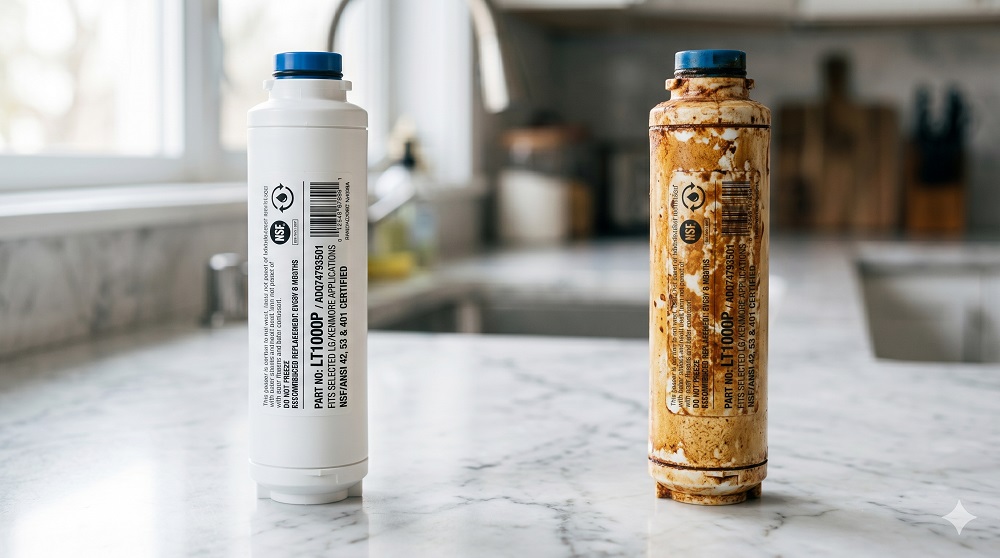
The iron problem specifically: Iron is the most common well water contaminant that damages refrigerator filters. As little as 0.3 mg/L iron (the EPA secondary maximum contaminant level for aesthetics) will begin clogging a carbon block filter. Well water with 1–2 mg/L iron — common in many regions — can clog a refrigerator filter in as little as 4–6 weeks rather than the standard 6 months.
The Right Solution: A 2-Stage Well Water Filter System
For well water homes, a single refrigerator filter is insufficient as a standalone solution. The correct approach is a two-stage system targeting different contaminant categories:
Filter Life on Well Water — The Real Numbers
Standard filter life ratings assume municipal water supply. On well water, actual filter life varies dramatically based on your specific water quality:
| Well Water Iron Level | Expected Filter Life (no pre-filter) | Expected Filter Life (with pre-filter) |
|---|---|---|
| Below 0.1 mg/L (minimal iron) | 4–5 months | 5–6 months (rated life) |
| 0.1–0.3 mg/L (low iron) | 2–3 months | 4–5 months |
| 0.3–1.0 mg/L (moderate iron) | 4–8 weeks | 3–4 months |
| 1.0–3.0 mg/L (high iron) | 2–4 weeks | 2–3 months |
| Above 3.0 mg/L (very high iron) | Days to weeks | 1–2 months (still challenging) |
If you are replacing refrigerator filters more frequently than every 4 months on a well water system, high iron is almost certainly the cause. Test your water and install a pre-filter before the refrigerator supply line.
How to Maintain Your Stage 1 Pre-Filter — The Schedule Most Well Water Guides Omit
The Stage 1 sediment pre-filter often clogs significantly faster than the refrigerator filter — especially in high-iron or high-sediment wells. Ignoring it defeats the purpose of the two-stage system and ultimately destroys the refrigerator filter it is supposed to protect.
If you have a clear pre-filter housing (strongly recommended over opaque housings for well water), hold a flashlight behind it monthly. A light amber tinge is normal. When the cartridge looks dark brown or resembles peanut butter — it is overdue for replacement regardless of the calendar date. A clogged sediment pre-filter forces your water pump to work harder, reduces flow to the refrigerator, and can allow iron breakthrough that destroys the carbon stage downstream.
Pre-filter replacement schedule by well water iron level:
| Well Water Profile | Pre-filter Change Interval | Visual Inspection Interval | Sign It’s Overdue |
|---|---|---|---|
| Low iron (<0.3 mg/L), low sediment | Every 3–6 months | Monthly | Noticeably reduced dispenser flow |
| Moderate iron (0.3–1.0 mg/L) | Every 4–8 weeks | Every 2 weeks | Cartridge visibly orange-brown |
| High iron (1–3 mg/L) | Every 2–4 weeks | Weekly | Dark brown, “peanut butter” appearance |
| Very high iron (>3 mg/L) or high sediment | Every 1–2 weeks | Every few days | Rapid flow reduction — consider additional treatment |
Pro tip: Install a pressure gauge on either side of the Stage 1 housing. A pressure differential of more than 10 PSI across the housing indicates the cartridge needs replacing — this method works even with opaque housings and gives you a precise, objective trigger rather than relying on visual inspection alone.
Best Refrigerator Filters for Pre-Treated Well Water
Once your well water has been pre-treated to remove iron and sediment, these NSF-certified refrigerator carbon filters perform excellently on the remaining contaminants:
| Brand | Best Well Water Filter Option | Price | Key Strength for Well Water |
|---|---|---|---|
| LG (2018+ models) | LT1000P compatible — NSF 42+53 | $19.95 | High-density carbon block handles residual iron traces after pre-filter |
| Samsung (most models) | DA29-00020B compatible — NSF 42+53 | $17.95 | Strong cyst and VOC reduction; good for surface-influenced wells |
| Whirlpool family | EDR3RXD1 compatible — NSF 42+53 | $16.95 | High flow rate maintains performance on slightly harder pre-treated water |
| GE (French Door) | RPWFE or XWFE compatible — NSF 42+53 | $20.95–$22.95 | GE’s carbon block density is among the highest for residual contaminant capture |
| Frigidaire | ULTRAWF compatible — NSF 42+53 | $18.95 | Good performance on pre-treated well water with moderate hardness |
Frequently Asked Questions
Find Your Refrigerator Filter — Well Water Ready
All our filters carry NSF 42 and 53 dual certification. Find your model for pre-treated well water systems. Same-day shipping, Guaranteed Fit Promise.
🔍 Find My Filter