How Often Should You Change Your Refrigerator Water Filter? (The Real Answer)
How Often Should You Change Your Refrigerator Water Filter? (The Real Answer)
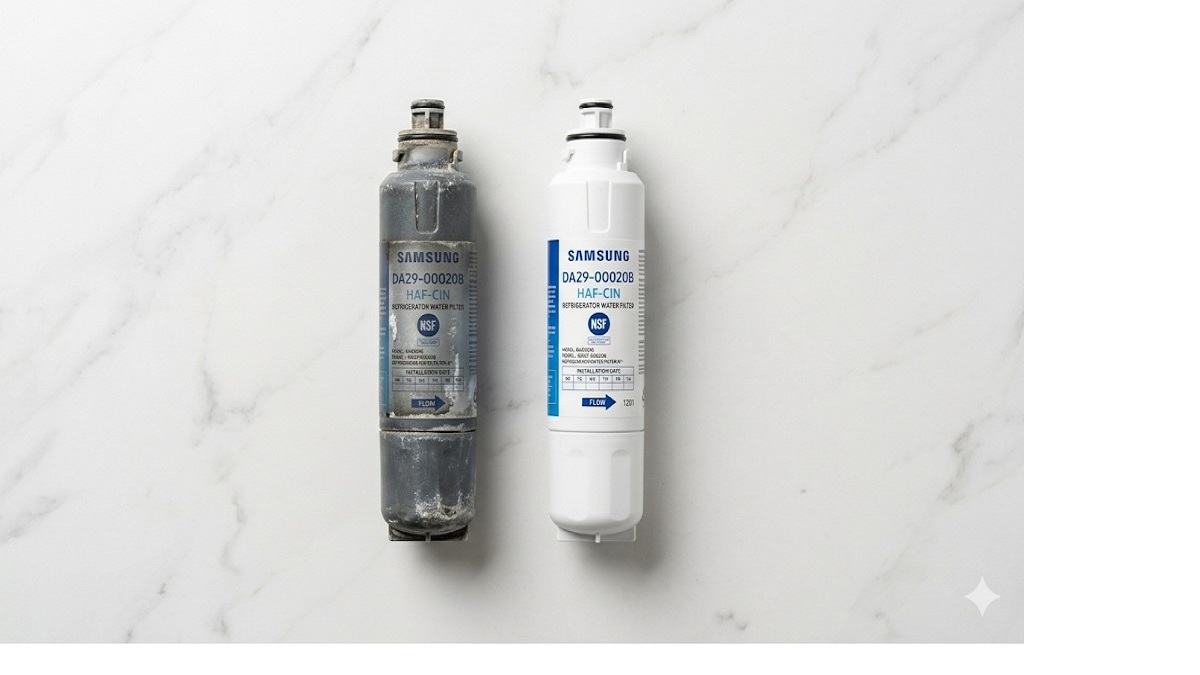
Every filter manufacturer prints the same thing on their box: Replace every 6 months. It is printed in the user manual. It is coded into the fridge’s timer. And for millions of households, it is genuinely wrong — either too frequent or not frequent enough.
The honest answer depends on your household size, water quality, and how much you actually use the dispenser. Here is the science behind the 6-month rule and how to calculate your real replacement schedule.
The standard recommendation of every 6 months or 200 gallons is a reasonable baseline for an average household of 3–4 people. Your actual ideal schedule depends on household size, local water quality, and dispenser usage. Some households need every 4 months. Others can safely go 9–10 months.
Why Filter Lifespan Is Not Just About Time
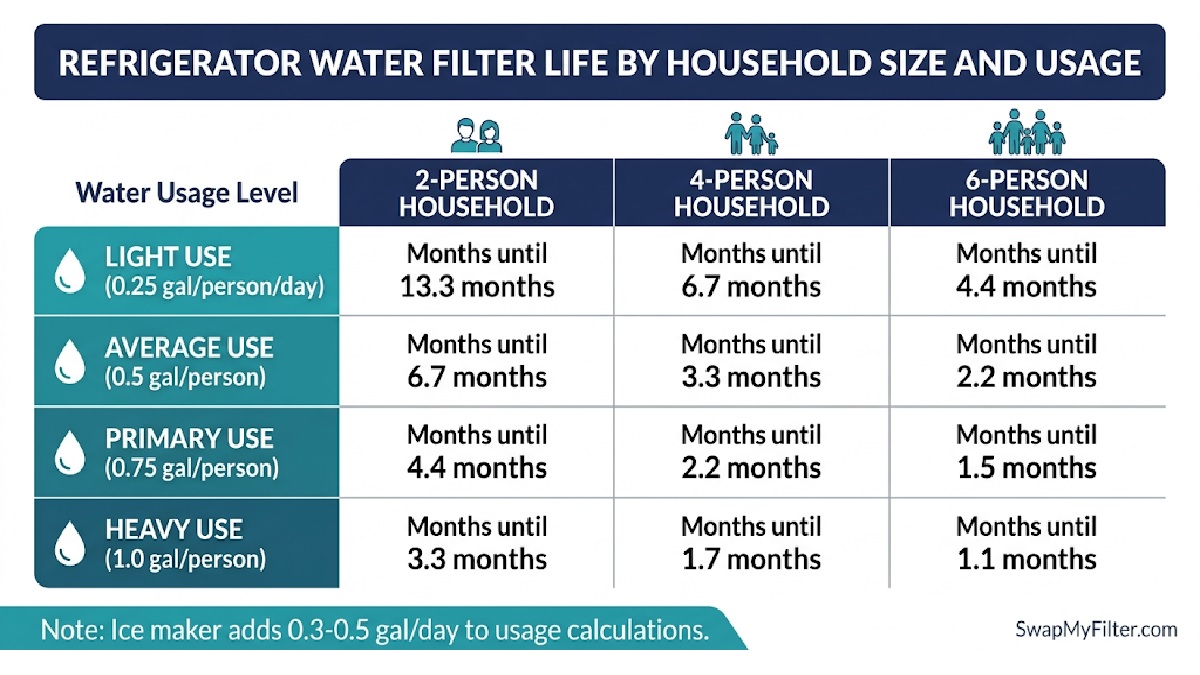
The “6 months” rule is a timer-based approximation. It assumes your household uses roughly 200 gallons of filtered water in 180 days — about 1.1 gallons per day for an average family. But that calculation varies enormously by household:
- A household of 2 using the dispenser occasionally might take 9–10 months to reach 200 gallons
- A household of 6 using filtered water for drinking, cooking, and ice might reach 200 gallons in 4 months
- Well water with high sediment can exhaust a filter’s physical capacity in 3 months regardless of volume
The true capacity limit is 200 gallons — not the calendar.
Your Replacement Schedule by Household Size
1–2 People
Light dispenser use, occasional cooking with filtered water
Replace every 9–12 months3–4 People
Average daily dispenser use and moderate cooking and ice
Replace every 6 months5+ People
Heavy daily dispenser use, frequent cooking, high ice demand
Replace every 4–5 monthsCalculate Your Exact Replacement Date
📐 Your Personal Filter Life Formula
Days Until Filter Exhausted = 200 ÷ (Number of People × Daily Gallons Per Person) Family of 4, each using ~0.5 gallons/day: 200 ÷ (4 × 0.5) = 100 days = 3.3 months Couple of 2, light use at ~0.25 gallons/day: 200 ÷ (2 × 0.25) = 400 days = 13+ monthsThis is your personal target — not the generic 6-month rule. Add ice maker usage (0.3–0.5 additional gallons per day for regular ice use) to your total.
Factors That Speed Up Filter Exhaustion
Hard Water
High mineral content means more total dissolved solids for the carbon to interact with, and more sediment accumulation that physically clogs filter media faster.
Agricultural or Rural Water Supply
Higher levels of pesticides, herbicides, and nitrates — even after municipal treatment — accelerate carbon saturation. Check your local CCR at EPA.gov/CCR.
Pre-1986 Home Plumbing
Homes built before 1986 may have lead pipes or lead solder. The filter works harder filtering lead, potentially depleting NSF 53 capacity faster.
Heavily Chlorinated Water
Some utilities spike chlorine seasonally. High chlorine loads exhaust the carbon’s chlorine-adsorption capacity faster than the 6-month average assumes.
6 Signs Your Filter Needs Replacing Now
- Chlorine taste or smell returns — the carbon is saturated and can no longer adsorb chlorine
- Water flow from the dispenser slows noticeably — sediment buildup is physically restricting flow through the filter media
- Ice tastes or smells off — your ice maker uses the same filtered water
- Water looks cloudy or has visible particles — the filter media may be breaking down
- Filter indicator light is red or orange — your fridge’s timer says it is overdue
- It has been more than 12 months since your last replacement — even light users should replace annually at minimum
What Happens If You Do Not Change It?
| Timeframe Past Due | What Is Happening | Risk Level |
|---|---|---|
| 1–2 months overdue | Carbon approaching saturation. Chlorine reduction declining. Taste may change. | Low — still partial filtration |
| 3–4 months overdue | Carbon substantially saturated. Lead and cyst reduction significantly reduced. | Moderate — meaningful protection loss |
| 6+ months overdue | Carbon fully saturated. Possible back-flushing of captured contaminants. | High — filter may be counterproductive |
| 12+ months overdue | Media potentially degrading. Risk of bacterial growth on saturated carbon. | Very High — replace immediately |
Frequently Asked Questions
Time for a Replacement?
Find your exact NSF-certified filter and get it delivered today. Same-day shipping before 2 PM EST. Free over $35.
🔍 Find My Filter