Does a Refrigerator Water Filter Remove Fluoride? The Honest, Science-Based Answer (2025)
Does a Refrigerator Water Filter Remove Fluoride? The Honest, Science-Based Answer (2025)
Why Carbon Filters Cannot Remove Fluoride — The Chemistry
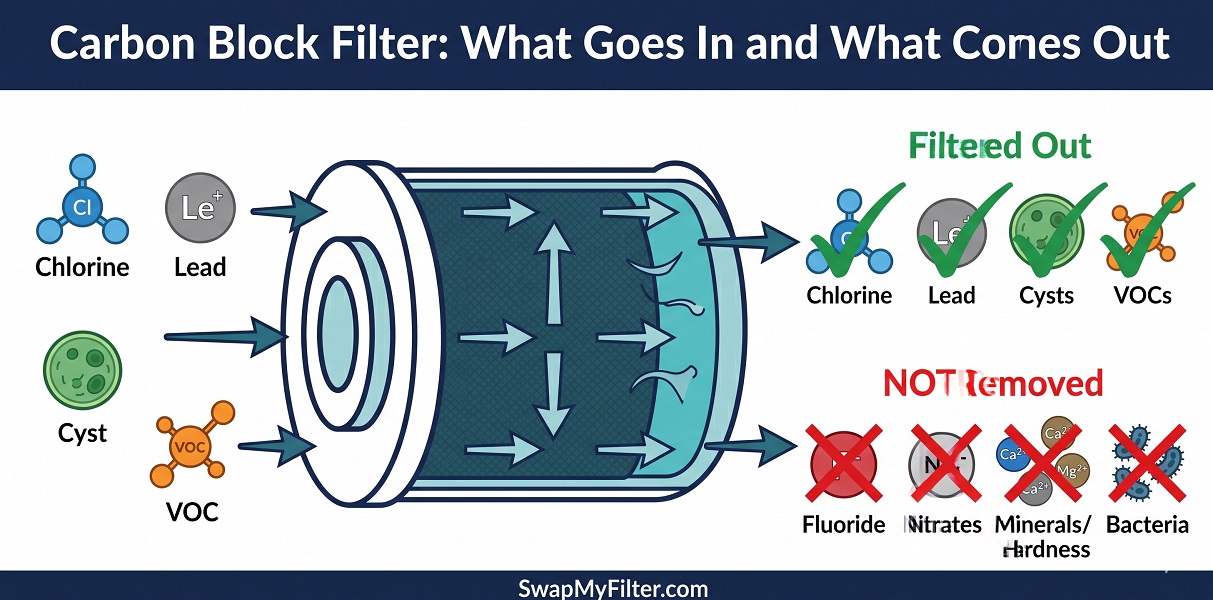
Activated carbon filters work through a process called adsorption — contaminant molecules in the water bond to the massive surface area of the carbon structure and are retained. This works extremely well for organic molecules (chlorine, VOCs, pesticides) and for lead, which bonds to carbon through ion exchange mechanisms.
Fluoride is a small inorganic anion (negatively charged ion) — specifically F⁻. Unlike organic molecules and heavy metals, fluoride ions do not bond to activated carbon surfaces under the conditions present in a refrigerator water filter. The water pressure, flow rate, carbon type, and contact time used in refrigerator filter design are all optimised for the contaminants that carbon does remove — not for dissolved mineral ions like fluoride.
What NSF Certification Actually Says About Fluoride
The NSF International certified products database shows that refrigerator carbon filters certified to NSF/ANSI 42 and 53 are tested and verified for specific contaminants. Fluoride is not among them — it is not part of the NSF 42 or NSF 53 standard scope:
| Contaminant | NSF 42 | NSF 53 | NSF 58 (RO) |
|---|---|---|---|
| Chlorine / taste / odour | ✓ Covered | ✓ Covered | ✓ Covered |
| Lead | ✕ Not covered | ✓ >99% | ✓ >97% |
| Cysts | ✕ Not covered | ✓ >99.95% | ✓ Covered |
| Fluoride | ✕ Not covered | ✕ Not covered | ✓ >90% (RO only) |
| Nitrates | ✕ Not covered | ✕ Not covered | ✓ Covered |
| Arsenic | ✕ Not covered | ✕ Not covered | ✓ Covered |
Should You Even Want to Remove Fluoride From Drinking Water?
This is the question most filter articles avoid — and it is one where the evidence matters more than the marketing. The CDC considers water fluoridation at the recommended concentration of 0.7 mg/L to be one of the ten great public health achievements of the 20th century, citing decades of evidence for cavity reduction — particularly in children and lower-income communities without regular dental care access.
The EPA sets a Maximum Contaminant Level (MCL) for fluoride of 4.0 mg/L — far above the 0.7 mg/L used in municipal fluoridation. The EPA also sets a secondary MCL of 2.0 mg/L for cosmetic effects (dental fluorosis in children from excessive consumption). At the regulated 0.7 mg/L level, fluoride in drinking water is considered safe by EPA, CDC, and WHO.
Some individuals choose to reduce fluoride intake for personal health reasons, and this is a legitimate personal choice. If you want to reduce fluoride from drinking water, the appropriate tool is an NSF 58 certified reverse osmosis system — not a refrigerator carbon filter. A carbon filter that claims to “reduce” fluoride without NSF 58 certification is making an unverified claim. For the genuinely small percentage of households where fluoride is a specific documented concern (e.g. area with natural high fluoride levels above EPA limits), professional water testing is the appropriate first step before selecting a treatment system.
What Actually Removes Fluoride — Certified Options
| Filter Type | Fluoride Reduction | NSF Standard | Best For |
|---|---|---|---|
| Refrigerator carbon filter (NSF 42+53) | None verified | NSF 42, 53 | Chlorine, lead, cysts, VOCs |
| Pitcher filter (standard carbon) | None verified | NSF 42 | Taste and odour only |
| Reverse osmosis system (NSF 58) | Greater than 90% | NSF 58 | Fluoride, nitrates, arsenic, PFAS |
| Activated alumina filter (NSF 58) | Greater than 90% | NSF 58 | Fluoride and arsenic specifically |
| Ion exchange (deionization) | Variable | NSF 58 (some) | Total dissolved solids reduction |
Frequently Asked Questions
Your Refrigerator Filter Excels at What Matters Most
NSF 42+53 certified filters remove lead, cysts, chlorine, and VOCs — the contaminants with the strongest evidence for health impact at typical residential levels. Find your filter in seconds.
🔍 Find My NSF-Certified Filter