NSF 42 vs NSF 53 Water Filter Certification: What Each Covers and Why Both Matter
NSF 42 vs NSF 53 Water Filter Certification: What Each Covers and Why Both Matter
Walk into any appliance store and you will see filters labeled “NSF certified” — but certified to what, exactly? NSF International maintains dozens of water treatment standards. For refrigerator water filters, two are relevant: NSF/ANSI 42 and NSF/ANSI 53. Understanding what each covers — and critically, what each does NOT cover — is the difference between a filter that improves your water’s taste and one that actually protects your family’s health.
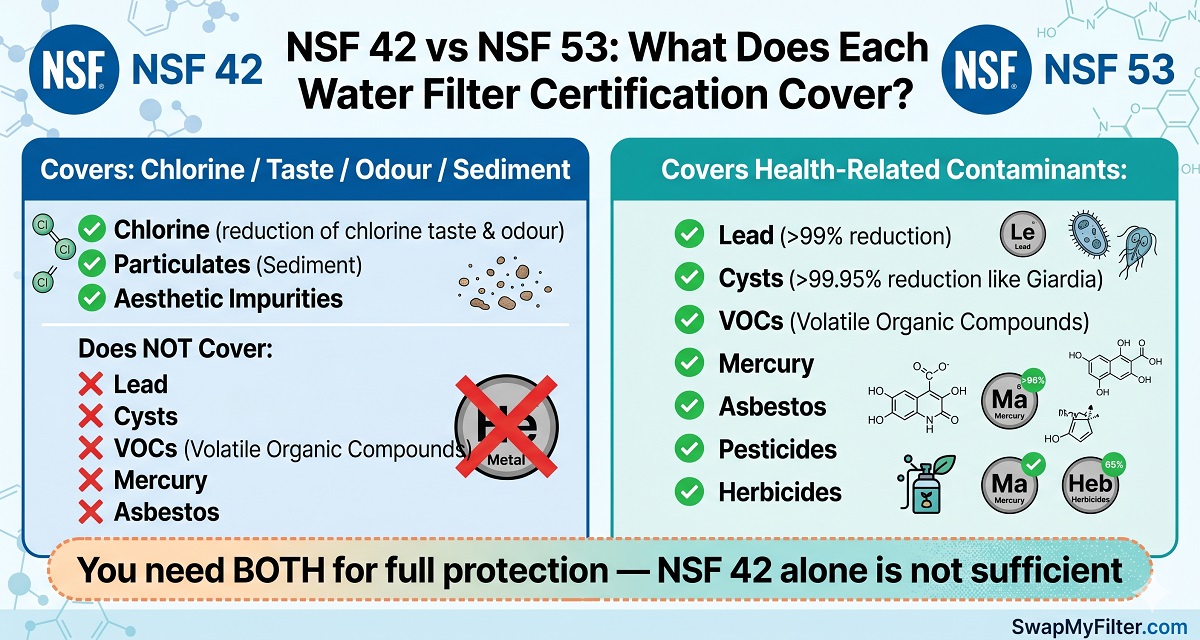
NSF 42 covers aesthetic contaminants (chlorine, taste, odour). NSF 53 covers health contaminants (lead, cysts, VOCs). You need both certifications for a refrigerator filter to be verifiably safe and effective. NSF 42 alone is not sufficient for health protection.
NSF 42 vs NSF 53 — Side-by-Side Comparison
Aesthetic Effects Standard
- Chlorine (taste and odour)
- Particulates and sediment (class I–VI)
- Taste improvement verification
- Odour reduction verification
- Nominal particle size testing
- Lead — NOT covered
- Cysts — NOT covered
- VOCs — NOT covered
- Mercury — NOT covered
Health Effects Standard
- Lead — greater than 99% reduction required
- Cysts (Cryptosporidium, Giardia) — 99.95%+
- VOCs (benzene, toluene, THMs)
- Mercury — verified reduction
- Asbestos — verified reduction
- MTBE (fuel additive)
- Turbidity
- Includes all NSF 42 requirements
Why NSF 42 Alone Is Not Enough
Many low-cost filters — both OEM and compatible — carry only NSF 42 certification. This makes the water taste and smell better by removing chlorine. It does not verify protection against lead, cysts, VOCs, or any of the health-affecting contaminants that are the real reason refrigerator filters matter for family safety.
The US EPA confirms there is no safe level of lead in drinking water. Lead has no taste. A filter certified only to NSF 42 may reduce chlorine taste effectively while allowing essentially all lead to pass through undetected.
A filter displaying “NSF Certified” on its packaging while carrying only NSF 42 certification is technically accurate — but highly misleading. The certification covers only taste and odour, not health-affecting contaminants. Always check the packaging for both NSF 42 AND NSF 53. If only one number appears, the filter has not been independently verified for lead or cyst reduction, regardless of what the marketing copy claims.
What NSF 53 Certification Actually Requires
NSF/ANSI 53 is a performance standard maintained by NSF International — an independent, non-profit certification organisation. To earn NSF 53 certification for lead, a filter must be tested by an NSF-accredited laboratory using a standardised protocol:
- Challenge concentration: 0.15 mg/L (150 ppb) lead — far above typical residential levels
- Required output: Filter must reduce lead to 0.01 mg/L or less (93%+ reduction minimum; most certified filters achieve 99%+)
- Test volume: Tested across the filter’s full rated capacity (200 gallons) — not just at start of life
- Independent testing: Performed by an NSF-accredited laboratory, not self-reported by the manufacturer
Contaminant-by-Contaminant Coverage Table
| Contaminant | NSF 42 | NSF 53 | Health Concern | Source |
|---|---|---|---|---|
| Chlorine (taste/odour) | ✓ | ✓ | Taste, aesthetic | Municipal treatment |
| Particulates/sediment | ✓ | ✓ | Aesthetic, turbidity | Pipes, mains |
| Lead | ✕ | ✓ >99% | Neurotoxin — no safe level | Old pipes, solder |
| Cysts (Cryptosporidium, Giardia) | ✕ | ✓ >99.95% | Parasitic illness | Water supply |
| VOCs (benzene, toluene) | ✕ | ✓ | Carcinogens | Industrial runoff |
| Mercury | ✕ | ✓ | Heavy metal toxin | Industrial, natural |
| Asbestos | ✕ | ✓ | Carcinogen when ingested | Old pipes, cement |
| MTBE | ✕ | ✓ | Fuel additive, carcinogen | Groundwater contamination |
| Turbidity | ✕ | ✓ | Pathogen carrier | Sediment, runoff |
| Fluoride | ✕ | ✕ | Dental (added intentionally) | Municipal treatment |
| Nitrates | ✕ | ✕ | Infant health risk | Agricultural runoff |
| PFAS (forever chemicals) | ✕ | ✕ | Emerging contaminant | Industrial, stain-resistant products |
How to Verify NSF Certification Yourself
Go to NSF’s Free Public Database
Visit info.nsf.org/Certified/DWTU/ — NSF’s official, publicly searchable certified drinking water treatment units database.
Search by Manufacturer or Brand Name
Enter the filter brand name (not the model number) in the search field. Look for entries showing your specific filter model.
Check the Standards Listed
Look in the “Standards” column for the result. Standard 42 means taste/odour coverage only. Standard 53 means health contaminant coverage. You want to see both listed for the same filter entry.
Verify the Specific Claims
Click through to the filter detail — the “Certified Claims” section lists every specific contaminant tested and the verified reduction percentage. Confirm lead appears with a reduction percentage (typically >99%) for NSF 53 coverage.
Any company can print an NSF logo on a package — the logo alone proves nothing. The certification number and specific standard (42, 53, or both) must be present. If a manufacturer cannot provide a specific certification number that returns results on the NSF database for their brand, the certification claim is false or expired. This is common among very low-cost marketplace filter sellers.
NSF 42 vs NSF 53 vs NSF 58 — What About NSF 58?
NSF 58 is the certification standard for reverse osmosis (RO) systems — a different water filtration technology entirely. RO systems under-sink or whole-home treat water at higher pressure and remove a broader range of contaminants including fluoride, nitrates, arsenic, and PFAS — things refrigerator carbon filters cannot address. If these contaminants are concerns in your specific water supply, an NSF 58-certified RO system is the appropriate supplemental solution. Your refrigerator’s NSF 42+53 certified filter provides the everyday layer of protection; an RO system provides deeper treatment if needed.
For your local water quality data including specific contaminant levels, check your municipality’s Consumer Confidence Report free at EPA.gov/ccr.
The Bottom Line on NSF Certification
For a refrigerator water filter to provide verified protection for your family, it must carry both NSF/ANSI 42 AND NSF/ANSI 53 certification. NSF 42 alone means better-tasting water. NSF 42+53 means better-tasting water that has been independently verified to reduce lead, cysts, VOCs, and other health contaminants. Every filter sold by SwapMyFilter carries both certifications — verifiable at info.nsf.org.
Frequently Asked Questions
Get NSF 42 and 53 Certified Filtration from $15.95
Every filter we sell carries independently verified NSF/ANSI 42 and 53 dual certification. Find your model in seconds — same-day shipping, Guaranteed Fit Promise.
🔍 Find My NSF-Certified Filter