Fridge Water Tastes Like Chlorine? Causes and Exact Fixes for Every Scenario
Fridge Water Tastes Like Chlorine? Causes and Exact Fixes for Every Scenario

A chlorine taste in refrigerator water — that faint swimming pool smell or sharp chemical edge — is one of the most common complaints we hear at SwapMyFilter. The good news: it almost always has a simple, inexpensive fix. The source depends on which of three scenarios you are in.
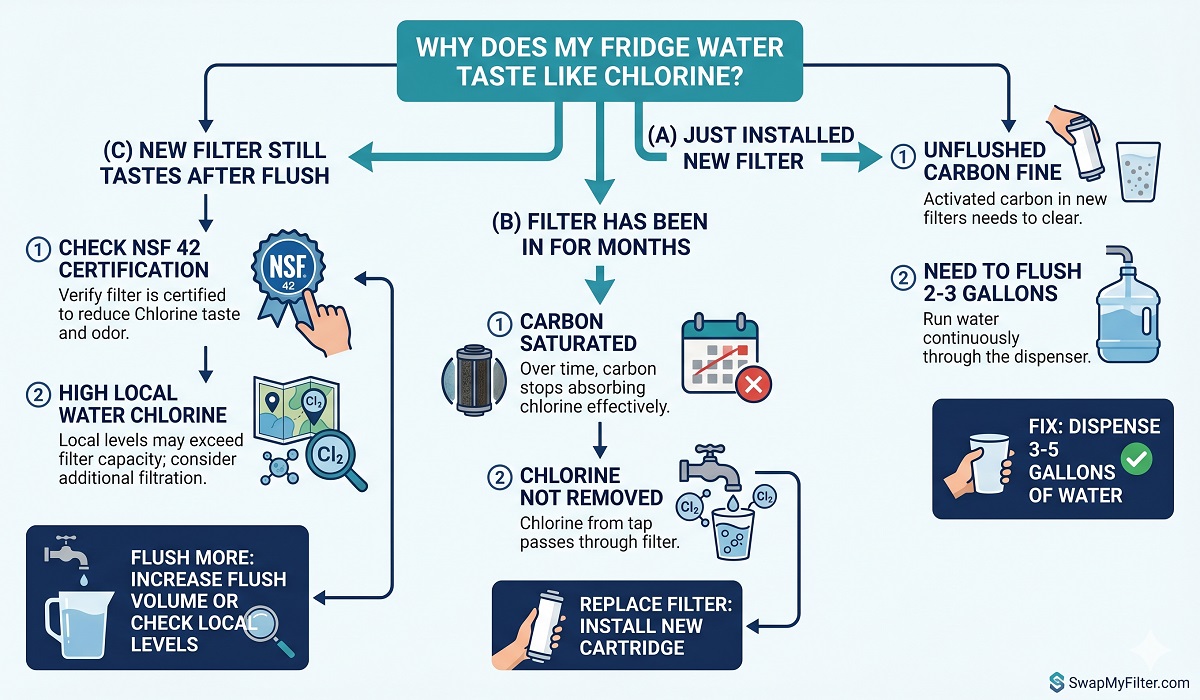
Scenario A: Just installed a new filter — water still tastes of chlorine → Fix: flush more water through the filter. Scenario B: Filter has been in for a few months and chlorine taste just returned → Fix: replace the filter. Scenario C: Replaced the filter but chlorine taste persists → Fix: check water pressure, filter type, and local water supply.
Scenario A: New Filter, Still Tastes of Chlorine
This is the most common scenario. A brand-new filter that still lets chlorine through has almost always not been flushed properly. New activated carbon block filters require 2–3 gallons of water to be run through them before the carbon fully activates and begins adsorbing chlorine effectively.
Fix: Flush More Water Through
Run the dispenser continuously for 4–6 minutes (2–3 gallons) and discard the water. Do not use the water in short bursts — continuous flow is required for proper activation. After flushing, wait 30 minutes for the carbon to fully stabilise, then taste again.
If Chlorine Persists After Full Flush
Confirm the filter is fully locked in position (not partially seated). Check your filter carries NSF/ANSI 42 certification — which specifically covers chlorine and taste reduction. An uncertified filter may not reduce chlorine at all. Verify at info.nsf.org.
Scenario B: Old Filter — Chlorine Taste Returned After Months
This is the clearest and most meaningful sign of an overdue filter. When activated carbon reaches saturation, it loses its ability to adsorb chlorine from passing water. The chlorine that was previously being captured now passes straight through to your glass.
The fix is straightforward: replace the filter. The chlorine taste will disappear within one glass after a new certified filter is installed and flushed. The US EPA recommends replacing refrigerator filters every 6 months for this reason — before the carbon reaches saturation.
Time to replace your filter?
Enter your refrigerator model number for an instant NSF-certified compatible match — same-day shipping.
Find My Replacement Filter →Scenario C: New Filter Installed, Chlorine Still Persists
If you have replaced the filter, flushed 2–3 gallons, and the chlorine taste remains strong, work through these checks:
Check Your Local Water Supply
Your municipality may have recently increased chlorination levels due to seasonal changes, infrastructure work, or a water advisory. Check your area’s current water quality at EPA.gov/ccr (Consumer Confidence Reports). Unusually high municipal chlorine levels can temporarily overwhelm even a fresh filter.
Verify Your Filter’s NSF 42 Certification
NSF/ANSI 42 specifically requires chlorine taste and odour reduction. An uncertified filter may provide little chlorine reduction regardless of how new it is. Check your filter brand at NSF’s certified database — every filter we sell carries this certification.
Flush Again — More Than You Think
In areas with very high chlorine levels, 3 gallons may not be enough for initial carbon activation. Try flushing 5–6 gallons and allowing the filter 1–2 hours to rest before use. High-chlorine water requires more carbon contact time before chlorine reduction becomes effective.
Check Your Ice Too
If water tastes fine but ice smells of chlorine, the issue is the ice maker drawing unfiltered or pre-flush water. Discard the first two full ice maker cycles after a new filter installation. Ice amplifies off-tastes because impurities concentrate as water freezes.
How Long Does Chlorine Taste Last After a New Filter?
After a proper 2–3 gallon flush, chlorine taste should be completely resolved. If you can still detect chlorine after flushing, the filter is not reducing it — either because the carbon is not yet activated (flush more), the filter is not correctly sealed, or the filter does not carry NSF 42 certification for chlorine reduction.
The complete guide to what refrigerator filters do and don’t remove: What Does a Refrigerator Water Filter Actually Remove?
Frequently Asked Questions
Fix Your Chlorine Taste — Get the Right Filter
All our filters carry NSF/ANSI 42 certification for chlorine taste and odour reduction. Find your model in seconds with same-day shipping.
🛒 Find My NSF-Certified Filter