Does a Refrigerator Water Filter Remove Lead? (The Science-Based Answer)
Does a Refrigerator Water Filter Remove Lead? (The Science-Based Answer)
The short answer is yes — but only if the filter carries NSF/ANSI 53 certification specifically for lead reduction. Not all refrigerator filters do. And even certified filters are only effective when replaced on schedule. Here is the complete science-based picture.
A refrigerator water filter certified to NSF/ANSI 53 reduces lead by greater than 99% from drinking water. An uncertified filter, or a filter certified only to NSF 42, provides little to no verified lead protection. Check your filter’s certification before relying on it for lead removal.
Why Lead in Drinking Water Is a Serious Concern
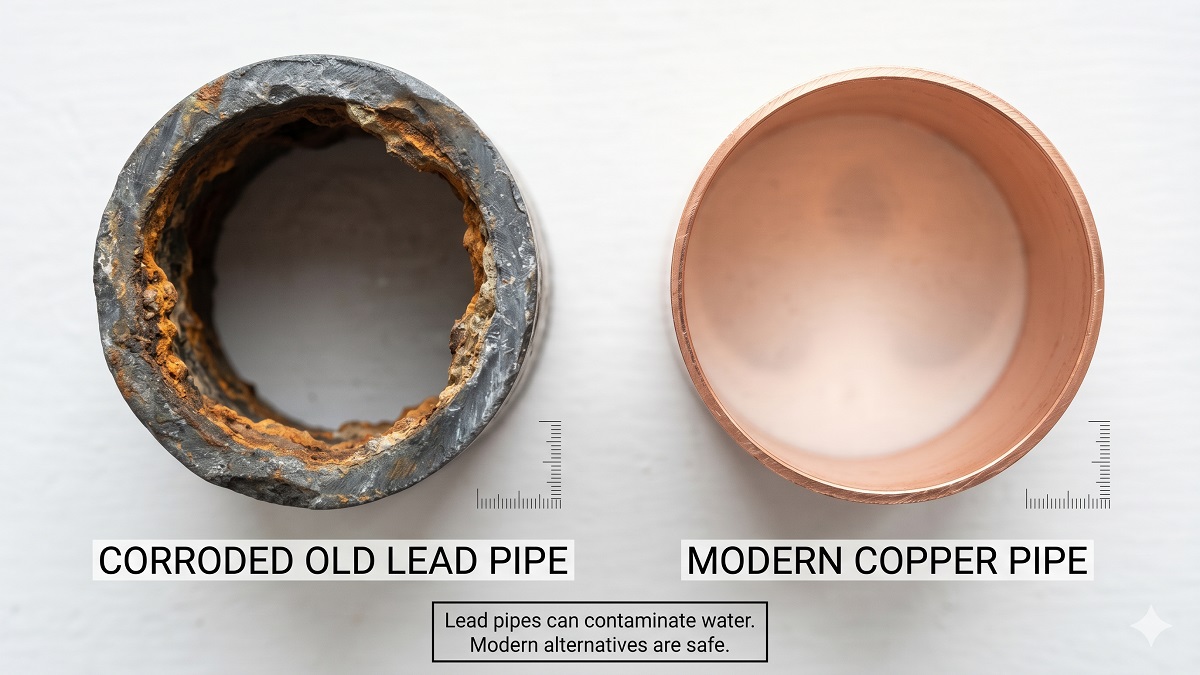
The US EPA states there is no safe level of lead exposure in drinking water. Lead enters drinking water primarily through corrosion of lead pipes, lead solder in home plumbing (used in homes built before 1986), and lead-containing brass fixtures.
The CDC confirms that lead exposure is particularly dangerous for children under 6 and pregnant women — even very low levels are associated with developmental delays, reduced IQ, and kidney damage over time.
How Refrigerator Filters Remove Lead
NSF 53 certified refrigerator filters use activated carbon block media — a compressed carbon structure with an enormous surface area — to adsorb lead ions from passing water through a process called chemisorption. Unlike simple carbon granules, carbon block filters create tortuous flow paths that force water into intimate contact with the carbon surface, trapping lead ions before they reach your glass.
This is different from how lead pipes actually contaminate water. Lead does not come from your municipal water supply — it leaches into the water as it travels through lead pipes or lead-soldered joints inside your home between the street main and your tap. This is why filtering at the point of use (your refrigerator dispenser) is an effective intervention.
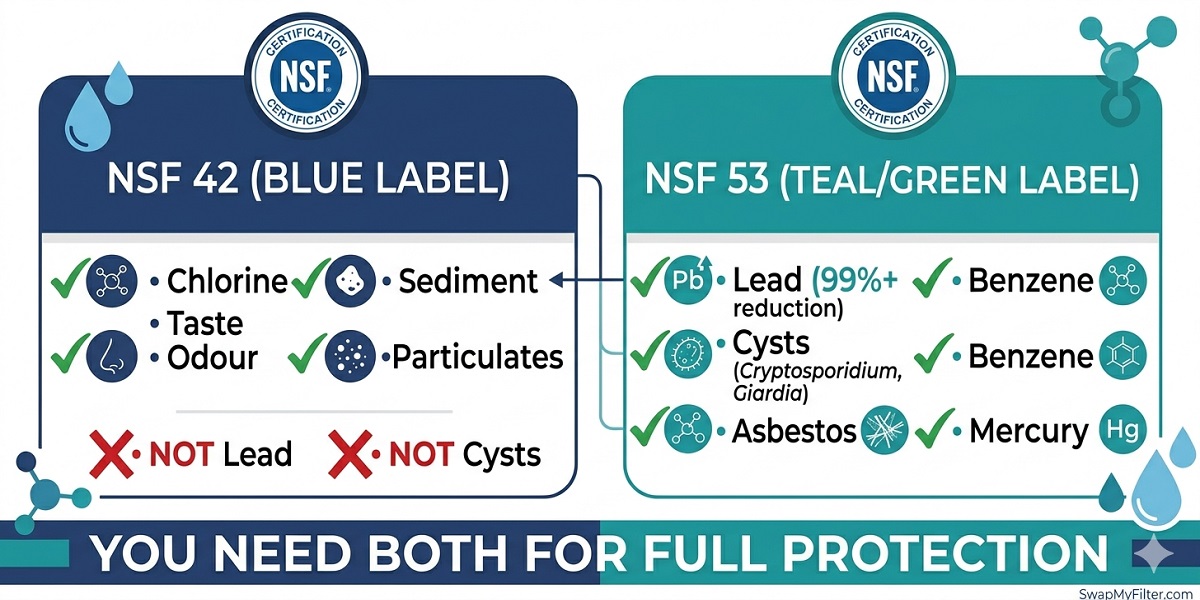
NSF 42 vs NSF 53 — The Critical Difference for Lead
| NSF Standard | What It Tests | Does It Cover Lead? | Required for Lead Protection? |
|---|---|---|---|
| NSF/ANSI 42 | Chlorine, taste, odour, particulates | No | No — insufficient for lead |
| NSF/ANSI 53 | Health-affecting contaminants including lead, cysts, VOCs | Yes — greater than 99% reduction | Yes — required for verified lead protection |
| NSF/ANSI 58 | Reverse osmosis systems | Yes — even higher reduction | Only for RO systems, not refrigerator filters |
Many inexpensive compatible filters carry only NSF/ANSI 42 certification — which covers chlorine taste and odour but has zero requirements for lead reduction. A filter certified only to NSF 42 may remove little to no lead. Always verify both NSF 42 AND NSF 53 certification at the NSF certified products database.
Lead Reduction by Filter Brand — Verified Data
| Filter | NSF 53 Certified? | Lead Reduction | Verification |
|---|---|---|---|
| LG LT1000P (OEM) | Yes | Greater than 99% | NSF International |
| LG LT700P (OEM) | Yes | Greater than 99% | NSF International |
| Samsung DA29-00020B (OEM) | Yes | Greater than 99% | NSF International |
| Whirlpool EDR3RXD1 (OEM) | Yes | Greater than 99% | NSF International |
| GE RPWFE (OEM) | Yes | Greater than 99% | NSF International |
| Maytag UKF8001 (OEM) | Yes | Greater than 99% | NSF International |
| SwapMyFilter Compatible (all brands) | Yes | Greater than 99% | NSF International |
Is Your Home at Risk for Lead in the Water?
🏚️ High Risk
Home built before 1986 · Lead service lines in your neighbourhood · Older brass fittings in plumbing · Previous positive lead test results in your area
🏠 Moderate Risk
Home built 1986–2000 · Some older fixtures still in use · Well water not recently tested · Rented property with unknown plumbing history
🏗️ Lower Risk
Home built after 2000 · Recent plumbing replacement · Municipal water with recent lead testing showing non-detectable levels
📋 Check Your CCR
Every US water utility publishes an annual Consumer Confidence Report listing all detected contaminants. Check yours free at EPA.gov/ccr — search your zip code.
When a Refrigerator Filter Is Not Enough for Lead
If your home has lead service lines (the pipe running from the street main to your house), a refrigerator water filter alone may not be sufficient — particularly if water sits stagnant in the lead line for several hours, which can result in very high lead concentrations.
In this situation, the EPA recommends:
- Running cold water for 30–60 seconds before using it (to flush standing water from the lead pipe)
- Using only cold water for drinking and cooking (hot water accelerates lead leaching)
- Considering a supplemental NSF 53 certified point-of-entry or under-sink filter as an additional layer
- Contacting your water utility about lead service line replacement programs, many of which are now funded through the 2021 Infrastructure Investment and Jobs Act
Bottom Line: Yes, With the Right Certification
A refrigerator water filter certified to NSF/ANSI 53 reduces lead by greater than 99%. This is a meaningful and valuable layer of protection for most households. Verify your filter’s NSF 53 certification at info.nsf.org. Replace on the 6-month / 200-gallon schedule — a saturated filter progressively loses its lead reduction capacity. For the full contaminant breakdown: What Does a Refrigerator Water Filter Actually Remove?
Frequently Asked Questions
Get NSF 53 Certified Lead Protection
Every filter we sell carries NSF/ANSI 42 and 53 certification — verified lead and cyst protection at a fraction of OEM cost. Find your filter in seconds.
🔍 Find My NSF-Certified Filter