What Does a Refrigerator Water Filter Actually Remove? (Full Breakdown with NSF Data)
What Does a Refrigerator Water Filter Actually Remove? (Full Breakdown with NSF Data)
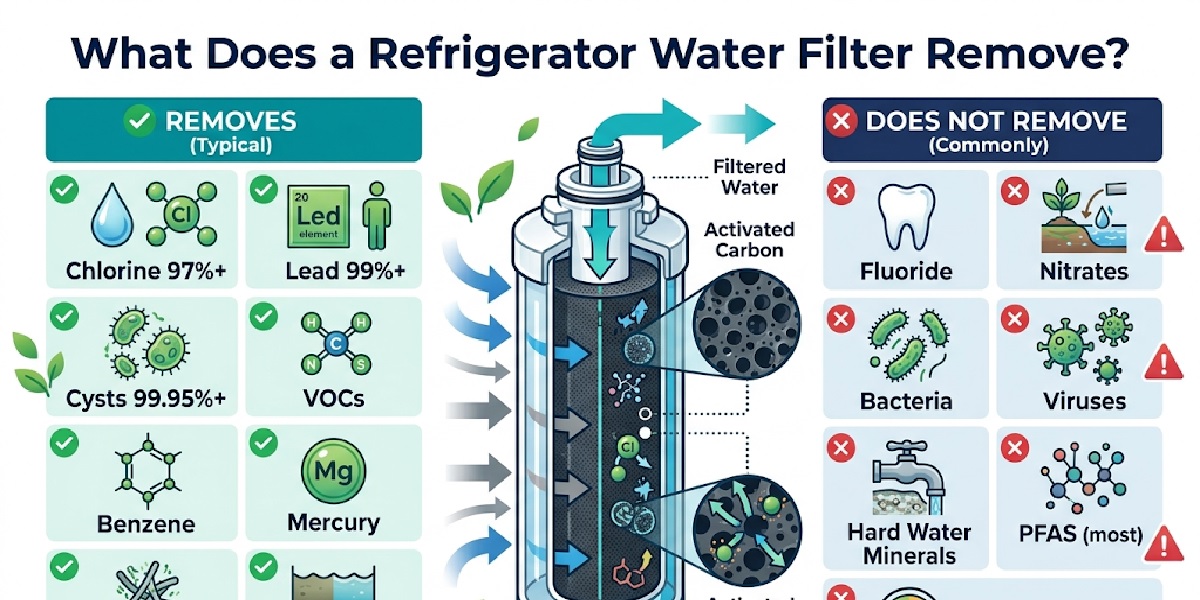
Most people trust their refrigerator water filter without knowing exactly what it is — and is not — removing from their water every day. The honest answer is nuanced: a certified refrigerator filter is genuinely excellent at certain contaminants, limited at others, and completely ineffective at a few important ones.
This guide gives you the full science-backed picture, with actual NSF-verified reduction percentages.
An NSF/ANSI 42 and 53 certified filter reduces chlorine, chloramine, lead, cysts, VOCs, benzene, mercury, asbestos, and turbidity. It does NOT significantly reduce fluoride, nitrates, bacteria, viruses, or dissolved minerals like calcium and magnesium.
How a Refrigerator Water Filter Works
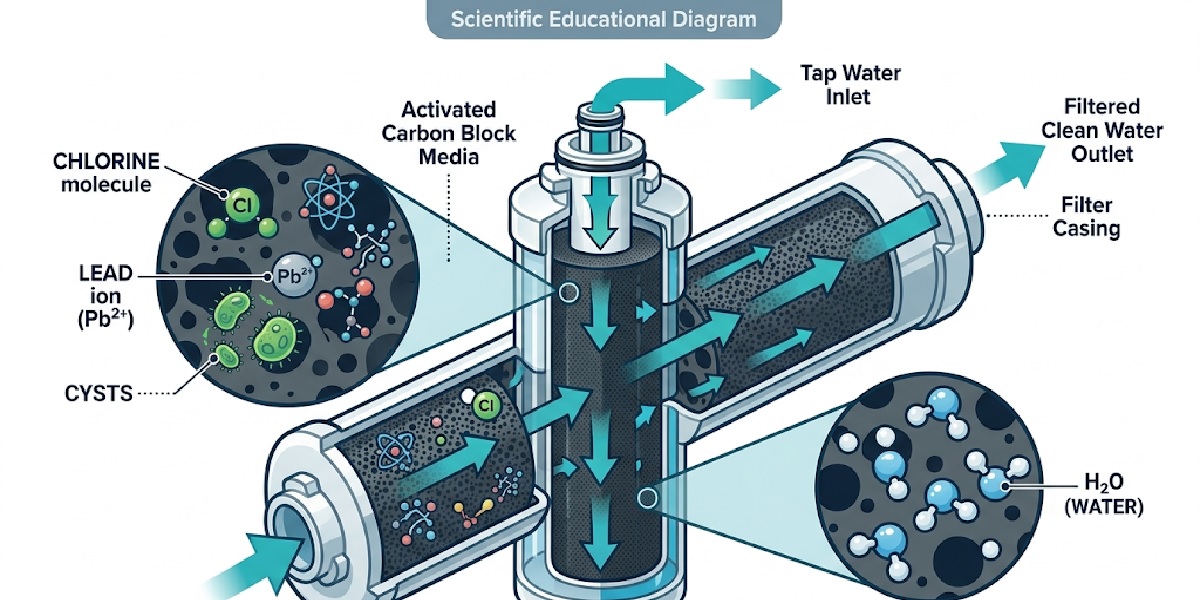
Standard refrigerator filters use activated carbon block technology. Activated carbon is an extraordinarily porous material — a single gram has the surface area of over 3,000 square metres. As water passes through the compressed carbon block, contaminant molecules adhere to the carbon’s surface through a process called adsorption.
Carbon block is excellent at removing organic compounds, chlorine, and certain heavy metals. It is not effective for inorganic salts, dissolved minerals, or microorganisms. This is why NSF certification matters — it tells you exactly which contaminants have been independently tested and at what reduction rates.
What Refrigerator Filters DO Remove
Chlorine and Chloramine
The primary disinfectants in municipal water treatment. Responsible for the “swimming pool” taste many people notice in unfiltered tap water.
Chlorine reduction: greater than 97% | Chloramine: greater than 80%Lead
Enters water through household plumbing, not the water supply. A neurotoxin with no safe level, particularly dangerous for children and pregnant women.
Lead reduction: greater than 99% (NSF 53 verified)Cysts (Cryptosporidium and Giardia)
Parasitic organisms that cause gastrointestinal illness. Carbon block physically traps these organisms through mechanical filtration.
Cyst reduction: greater than 99.95% (NSF 53 verified)VOCs and Pesticides
Industrial chemicals, pesticides, herbicides, and petroleum derivatives from agricultural runoff and industrial discharge. Carbon block is highly effective at adsorbing organic compounds.
Typical reduction: 85–99% depending on compoundBenzene
A known carcinogen found near industrial areas and petroleum-contaminated water supplies. Activated carbon has very high affinity for benzene molecules.
Benzene reduction: greater than 99%Mercury and Heavy Metals
Mercury and certain other heavy metals from industrial discharge and geological formations are effectively adsorbed by activated carbon.
Mercury reduction: greater than 96%Turbidity and Sediment
Fine sediment, rust particles, and suspended solids. Carbon block physically traps particles above its micron rating, improving water clarity.
Turbidity reduction: greater than 99%Asbestos
Microscopic fibres entering water through degrading pipes in older buildings. Carbon block mechanically traps asbestos fibres effectively.
Asbestos reduction: greater than 99%What Refrigerator Filters Do NOT Remove
This is the section manufacturers prefer to omit. Here is what an activated carbon refrigerator filter cannot significantly reduce:
| Contaminant | Removed? | Why Not | What Can Remove It |
|---|---|---|---|
| Fluoride | ✕ No | Fluoride ions too small and polar for carbon adsorption | Reverse osmosis, activated alumina |
| Nitrates and Nitrites | ✕ No | Highly water-soluble inorganic ions — carbon cannot bind them | Reverse osmosis, ion exchange |
| Bacteria | ~ Partial | Not certified as bactericidal — inconsistent trapping only | UV purification, NSF 55 certified systems |
| Viruses | ✕ No | Viruses are smaller than carbon’s pores | UV treatment, reverse osmosis |
| PFAS (forever chemicals) | ~ Limited | Some PFAS adsorbed but not certified comprehensively | High-contact-time carbon, reverse osmosis |
| Hard Water Minerals | ✕ No | Calcium, magnesium pass through carbon unchanged | Water softener, reverse osmosis |
| TDS (Total Dissolved Solids) | ✕ No | Carbon removes specific compounds, not all dissolved solids | Reverse osmosis |
Check Your Local Water Quality — Consumer Confidence Report
💡 Find Out What Is Actually in Your Tap Water
Every US public water utility is legally required by the EPA to publish an annual Consumer Confidence Report (CCR) — also called a Water Quality Report. It lists every contaminant detected in your local supply, the levels found, and the health implications.
Reading your CCR tells you: whether lead is detectable in your supply, whether agricultural chemicals like nitrates are present, and whether any PFAS compounds have been reported. This determines whether a standard refrigerator filter covers your needs — or whether you need additional treatment.
Find your report in 30 seconds: Go to EPA.gov/CCR, enter your zip code or utility name, and your annual report is listed free.
Frequently Asked Questions
Make Sure Your Filter Is Actually Certified
An uncertified filter provides no verified protection regardless of its claims. Every filter at SwapMyFilter carries NSF/ANSI 42 and 53 certification — verifiable at NSF’s public database.
🔍 Find My NSF-Certified Filter